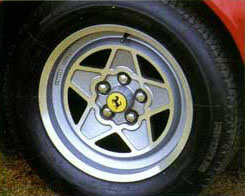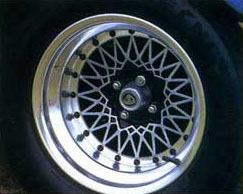



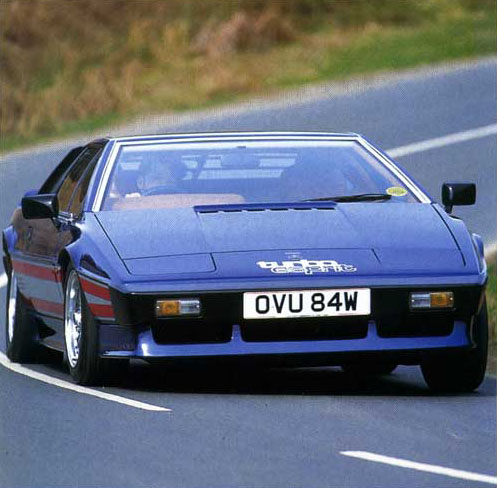
A hot wind from Hethel . . . blows Maranello no good
Classic and Sportscar August 1995
In
1980 Lotus gave its mid-engined Esprit the engine it deserved: a
2.2 litre turbo. Suddenly the once modestly endowed Esprit –
which had never delivered the punch its exotic looks promised –
was vying successfully for the same well-heeled 20 grand plus custom
as Porsche and Ferrari.
Tanned poseurs could still revel in those flamboyant wedgy looks,
but the poise and panache of the Esprit’s fine chassis was
matched by blistering turbocharged urge. At last Lotus had joined
the supercar elite, albeit in the junior league.
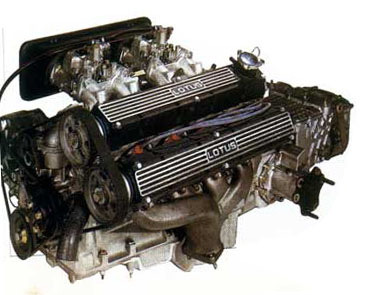
And all this from a low-born twin-cam four, simply but efficiently
boosted by a Garrett turbocharger to 210bhp: there was no injection
- the Turbo still ran big Dellorto carbs – and no fancy black-box
electronics or engine management to complicate the issue.
Ferrari in particular must have been worried by this new young pretender
to its long held junior supercar crown. Not only did the Esprit’s
mid-engined layout match the sophistication and driver appeal of
the 308GTB but the Lotus was faster – comfortably so. Recently
strangled by new fuel injection, the output of the GTBi had tumbled
to 214bhp, an embarrassing comedown from the heady 255bhp of the
early carburetted, glass-fibre-bodied cars.
Maranello hit back in 1984 with the Quattrovalvole, a new four value
per cylinder V8 – still injected – upping the stakes
to 240bhp. Now exchanging equal blows with the blown Brit through
the gears up to 100mph, the QV could then pull decisively away up
to a similar 150mph plus top speed.
But the Esprit’s trump card was price: though never marketed
on a value for money ticket (it was one of the world’s most
expensive four-cylinder cars after all) it still undercut the 308
by a princely £8000 in the mid ‘80’s.
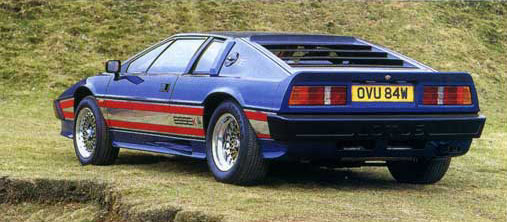
Today it really is a bargain: the rare limited edition Essex Turbo
you see here will make only about a third of the Ferrari 308’s
£30,000.
Here is the nub of the matter, the pretext for this junior supercar
face-off. Half the number of cylinders can’t mean the Esprit
is half the car, especially as they are turboed, but does snob appeal
and cachet – the Gucci factor – really account for such
a huge differential?
THE ESSEX EYEFUL
In looks, the Lotus doesn’t wear its years well. So much for
the ‘Essex’ livery whose tinfoil flanking and dubious
graphics taint the razor-edged simplicity of the original Ital Design
Esprit. It’s all very postured, very ‘80’s.
Esprit owner Paul Dewey – a Coventry car maker who drives
an Alfa GTV6 as everyday transport – plays the practicality
card in defence of his mini Esprit, bought from these pages in June
1994 for £9400: “It’s plastic, it’s got
a galvanised chassis and it’s a basic four-cylinder engine
with a very basic turbo: it’s a 150mph supercar but I can
service it myself and buy most of the bits from Halfords.”
Being an Essex (17th built) his Esprit Turbo enjoys air conditioning
and a then state-of-the-art Panasonic stereo mounted in the roof
panel as well as the lurid graphics. Customer resistance to the
latter hastened the introduction of a standard trimmed and cheaper
Esprit Turbo from the spring of 1981.
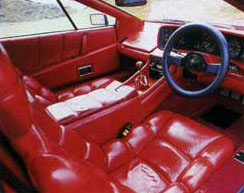
Lavishly trimmed in wrinkly, lip-gloss red hide, the Esprit’s
cabin is cossetingly hedonisitic. Recumbent in its soft embrace
you instantly notice two things : the pedals jostle for space in
the narrow foot-well (it’s easy to press two at the same time)
and the view out rearwards – hindered by the thick tailgate
slats and the chunky C-pillar – is appalling, problems common
to the standard Esprit that should have been tackled on the Turbo.
Switchgear and door furniture sourced from mass-market machinery
smile back at you like old friends (hello Maxi door handles, hello
Maestro switches) but otherwise this padded boudoir of a cabin is
well worthy of a supercar.
Moving off, the clutch feels saloon-car ordinary – light,
smooth, a bit woolly even on its point of bite. The gear change
is crisp enough as you click it through the short-throw gate, fifth
out on the dog-leg. At town speeds the ride is taut but not uncomfortable
and already you can tell that steering is going to be nice: it’s
sharp, direct and loaded with feel. Lovely wheel too, a chunky rimmed
leather Momo.
Smoothly delivered torque makes the Esprit an easy car to potter
in – it’s almost like a big lazy 3-litre – pulling
happily in fifth with the throttle floored from just 1500rpm.
Real pull commences at 2000rpm and continues in a smooth, relentless
surge right around to 7000rpm when the needle bounces off the rev
limiter. No lethargic lag, no embarrassing pre-ejaculatory wallop:
just a solid relentless flow of turbo-boosted potency that never
fails to impress. Other than the turbo gauge flickering in your
lower peripheral vision there is no noticeable point at which the
boost comes in, the mark of a properly set-up turbocharger.
Closely stacked gears keep this action flowing superbly, though
the shift feels a little sticky, with poor definition across the
gate. Muted and remote at lower speeds, the twin-cam never emits
anything more than a well-mannered growl when extended, overlaid
by the twitter of a closing turbo wastegate after each gear shift.
It’s classy but undistinguished, and unlikely to prickle the
neck hairs much: look elsewhere for exciting acoustics.
Such is the free-revving nature of the engine that the rev limiter
comes in easily and frequently in the intermediates – that’s
62mph in second and 92mph in third – so you have to watch
your pace if you want to keep a low, legal profile.
Not that the Esprit’s massively-shod chassis is ever likely
to show you up. It mixes the go-kart directness and responses of
a raw racer with the benign safety factor of a family saloon. Get
it very wrong in this car – with brakes or throttle –
and it will always look after you. Steering is overly, so faithfully
responsive and direct that it rarely needs more than flexed wrists
to change direction. With such small amounts of roll, such massive
adhesion and so little loading-up of the steering through fast open
turns, you sometimes only have the G-forces inside the car to tell
you how fast you are going: the Esprit really is that balanced and
un-dramatic. It inspires total confidence as it sweeps dismissively
through corners at speeds that would seem like suicide in most cars
going at half the rate. Lift off and you merely tighten the car’s
line, throttle down and you cancel out the gentle under-steer or,
if the corner is tight and the gear low, gently push the tail out.
Bad surfaces need not temper your pace, as the Esprit’s amazingly
supple, perfectly damped suspension seems to get more comfortable
the faster you go. The brakes, if a little light and mushy in pedal
feel, offer superbly powerful and stable high-speed stopping power.
No worries there.
MADE IN MARANELLO
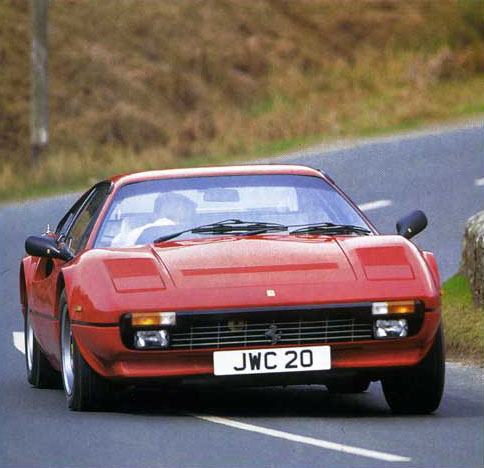
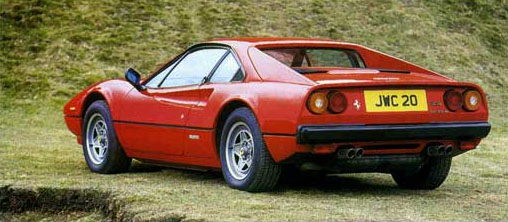
Subjectively, the Ferrari can’t match the race-bred handling
precision of the Lotus. But it’s partly redeemed by stunning
looks – softer and more sensual than those of the angular
Esprit – a sweet and potent engine and a feeling of well-bred
strength and stamina.
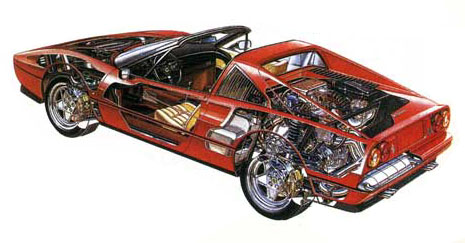
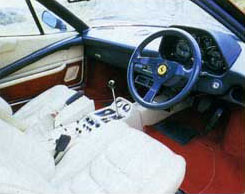
It’s lighter inside the cream-leather trimmed 308 –
vision out is much better – and also more functional, though
not short on luxuries like air conditioning and power windows. Looking
around you’ll be pushed to recognise any Fiat/Alfa sourced
hardware in here: in fact, almost everything looks bespoke, from
the solidly wrought column stalks and toggle switches to the closely-grouped
dials in the narrow binnacle. The quality is good too: Ferrari was
beginning to wake up to the challenge of Porsche in the early ‘80’s.
Pedals are ideally spaced, the driving position a typical long-arm,
bent-leg affair, the steering position – another thick-rimmed
Momo – a little bus-driverish. The front wheel wells encroach
heavily into floor space, as they do in the Esprit.
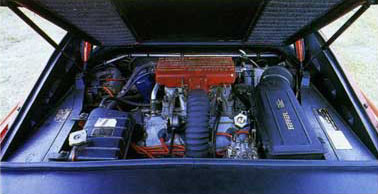
Injection means easy starting and un-temperamental low-speed running
from a V8 engine that sounds far busier – but not much more
exciting – than the Lotus unit. Massively tractable –
it will lug clean and strong from virtually tick over in fifth –
the Ferrari V8 has such a broad and muscular power-band that it
feels marginally stronger than even the Lotus on the road, urged
along by closely-stacked ratios. Contemporary figures prove it,
the Italian gaining most advantage above 100mhp when its extra 30bph
really begins to tell.
With such a clean and eager throttle response it feels a smooth,
strong, unburstable engine, if not an especially nice one to listen
to. Aggressive but not melodious, heavy on the belt-thrash, it lacks
the banshee scream of the old Dino V6, never mind the classy, deep-chested
timbre of a V12. Tamed by a single exhaust box it is curiously unexciting,
yet it’s never quiet: while the Lotus will cruise fairly unfussily
the Ferrari is buzzy out on the motor-way, and your car drums are
accosted by engine and tyre roar.
The uniform weight and precision of the Ferrari’s controls
can make the Lotus feel toy-like. Crisp, metallic and accurate,
the gated gearshift likes to be slammed hard around the perfectly
spring-loaded, click-clack open gate. It is well complemented by
a heavy, positive clutch and a brake pedal that is hard in feel
but which offers progressive and strong retardation once the discs
are warm. The throttle gives fine, linear control, adding to the
well-wrought precision you don’t get with the Lotus.
Less endearing at first is the steering, which is ultra weighty
at low speeds and hernia-inducing when you have to park. Lots of
incongruous shuffling is required when you’re driving around
town. Through tight turns there is strong understeer, easy to cancel-out
with a deep stroke of the throttle, and a surprising amount of roll.
As our confidence builds, you can begin to really load up the front
end with hard cornering forces and it is only then that the helm
gradually shakes off the deadness lightens and begins to communicate
nicely.
Even then it lacks the lightness and delicacy of the Esprit: the
308 does not hold its line with such pin-sharp accuracy or change
the direction of its nose with such sensational, kart-like immediacy,
Steering, though good, does not communicate to faithfully, and the
car never settles into a turn with the magical finesse of the Esprit
Turbo.
That isn’t to say the 308 is a dynamic dullard. Far from it
: charging through fast, clear sweeper impervious to potholes and
bumps thanks to a supple and compliant ride, the Ferrari feels poised
and secure, classy and composed. Its upper limits and similar and
its ultimate behaviour – mild lift-off tuck-in or an easy-to-catch
slide – is just as forgiving as the Lotus.
VERDICT
The Lotus was the better car on the day. So why did I want the Ferrari?
Because in the final analysis it feels more substantial than the
Lotus. The detailing is nicer, the engine feels stronger and, to
my eyes, it is by far the prettier car.
All that not withstanding the fact that the Esprit has masses to
offer for 20 grand less. If you’re looking for the best in
mid-engined ‘80’s handling then it has to be the Esprit
Turbo. Great steering, massive grip, unshakeable poise – it’s
got the lot, this car, wrapped in an exotic body that will turn
heads with the best of them. Performance won’t leave you wanting
either, so don’t be fooled by the lack of cylinders; when
that blower is puffing hard not much will catch you in an Esprit
Turbo. Even if it wasn’t such a bargain it would still be
a great car.