




Click to enlarge
The
Rebirth of a Top Performer
When Autocar first tested the Lotus Esprit Turbo
in 1981 the results were impressive.
So what's so good about this 1984 version? Plenty, according to
Andrew Kirk
AutoCar
December 1984
Photographs are by Rick Cordell
We
first tested the Lotus Esprit Turbo in 1981 and were impressed then
by the thoroughly engineered conversion which delivered such devastating
performance. Some three years on, the latest Esprit Turbo has proven
to be even better.
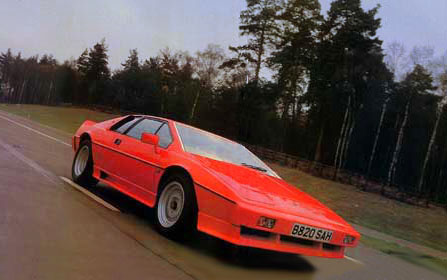
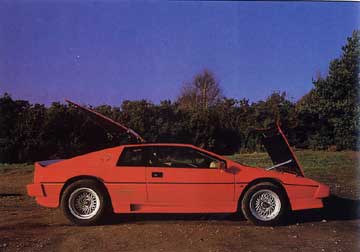
Visually, one would be hard-pressed to tell the two models apart,
but there are a number of significant under-skin changes that have
elevated the revised Esprit Turbo to new heights, specifically in
terms of ride, overall handling and refinement.
On the outside, BBS light alloy wheels have replaced the earlier
Compomotive three-piece items while the low profile Goodyear NCTs
are slightly different in construction to complement the suspension
changes. The tyres are made from a revised rubber compound, have
a redesigned tread support and are of much softer construction overall,
with a firmer sidewall. Overall dimensions of both wheel and tyre
remain unchanged. Colour-keyed bumpers are a recent feature and
responsible for the more 'complete' look that accentuates the already
distinctive Giugiaro styling.
It is a sign of the thorough initial development that so little work on the turbocharged 2174cc four-cylinder engine has been deemed necessary. It is still every bit as impressive in output and flexibility as our initial findings suggested; in fact, the latest car is slightly quicker throughout the gears and only failed on top speed. We lapped the high-speed bowl at Millbrook flat out in fifth gear at 138 mph and 6100rpm, well below the 149 mph figure for the previous car. Our progress, however, was hampered by the fact that we were testing at night with the pop-up headlamps raised. According to Lotus, these knock between 250 to 300rpm off maximum revs, so adding this to our overall figure suggests that a more comparable 145mph at 6400rpm ought to be possible, though this is well over the power peak of 6000rpm bearing in mind the 22.7mph/1000rpm gearing in fifth of the Esprit.
Acceleration from rest is breathtaking, to say the least. The mid-engine configuration places weight in the optimum position for grip, but even so, 210bhp in a relatively light car is enough to set the tyres alight when dropping the clutch at 4800rpm. Grip soon takes over, 8psi registers on the boost gauge and 30mph comes up in only 2.5 secs, 60mph in 6.1 secs – we did manage 5.9 seconds on one occasion – and 100mph in 15.8 secs. Impressive enough figures when one considers that we were hampered by the rev limiter which cut in early at 6900rpm rather than the correct 7100rpm. Incremental times in the gears are as good, or marginally better, than our previous car from mid-revs onwards. The time from 50 to 70mph to top is now 6.6 seconds – a reduction of 1.9 secs, from 70 to 90mph, 6.7 secs – two seconds quicker – and from 100mph to 120mph, 2.5 seconds faster at 10.6 seconds.
It
is when cruising at high speed that the turbo engine is most impressive
– floor the throttle at 80mph in fourth and 100mph comes up
in only 5.3 seconds, turbo lag is less pronounced at higher revs
and the power surge remains impressive. At the other end of the
rev range, the Turbo Esprit is quite happy in busy urban driving
and only hiccoughs slightly on full-throttle openings. To be fair,
this is not the ideal situation for such a sporty car; it is most
at home on fast country lanes or the open road where one can exploit
and double overhead camshafts, four valve per cylinder flexibility
to the full.
It is a fairly quiet engine at speed, but noisy at lower speeds
where there is a pronounced exhaust rasp. The pulse smoothes out
at higher revs and one only hears a faint whistle from the turbo
as boost builds. Tyre roar is quite pronounced, but this is not
surprising considering the wide section tyres. The biggest source
of irritation, however, comes from the poor window and door seals
– ironic on a shape as aerodynamic as this. Another source
of minor annoyance with the Esprit Turbo is the amount of time it
takes to brim the car due to the fact that the filler neck will
not accept full fuel delivery – even with the two filler caps
removed. Reasonable progress can be made up to around 40 litres,
but the job then becomes more time-consuming as the additional 40
litres or so is pumped in cautiously, to avoid blowback and vapour
lock. It is an unworthy attribute of a car costing over £20,000.
Fuel consumption worked out at 17.6mpg, a figure slightly worse than the previous car's 18mpg overall. It dropped to 15.6mpg on one occasion and reached as high as 21.9mpg on another. We felt this about average for the type of performance the Turbo Esprit offers, though it does limit the driving range to a realistic 250 miles between fills.
As expected, Lotus engineers have waved their magic wand over not only the engine conversion, but also handling. This was perhaps an area of some criticism on the previous Turbo Esprit with its strong understeer build-up in cornering extremes, though essentially handling was fairly neutral. The old car had what Lotus terms a 'soft platform' and stiff tyres; that is, the suspension was biased towards ride comfort rather than outright handling. The latest car has shown a reversal in that trend: it has a 'stiffer platform' and softer tyres. Spring rates and the roll ratio remain unchanged, but larger capacity dampers are used at the front and smaller ones at the rear. The anti-roll bar is now responsible for limiting roll only, whereas before it also acted as a brake reaction rod, and, in this role, was responsible for a certain amount of braking instability. This has been overcome by giving the anti-roll bar the single function of controlling roll and by fitting wide-based lower wishbones with built-in anti-dive to control the suspension geometry under hard braking and to limit castor change. The overall results have elevated the vehicle's responsiveness at low speeds and made the car less twitchy and unstable at high speeds or in severe turn-in manoeuvres. The overall feel, however, it still very much of neutral handling.
A
session on the Dunlop handling circuit at MIRA revealed that in
extreme's lifting off the power in mid-corner would provoke the
tail of the Esprit to step out of line – this can be countered
with a quick application of steering lock, but the driver's reactions
must be sharp. If in a particularly bold frame of mind, it is quite
possible for him to flick the Lotus into oversteer in a bend and
power round in a satisfying, throttle-controlled slide – not
recommended practise on the road, but great fun on the test track.
The steering rack is changed to give 2.8 turns from lock to lock
as opposed to 3.1 for the previous car, and with such precise rack
and pinion steering any slight exaggeration of wheel movement can
upset the handling in cornering extremes. The Esprit is certainly
not for the ham-fisted driver and will reward him with twitchy behaviour.
We were amazed at how one could pick a line through a bend and keep
it, even if more power was applied with the car apparently on the
limit. Overall levels of grip are quite remarkable from the restructured
NCTs.
Beside the suspension changes, there have been improvements to the steering geometry, to prevent self-steering in certain conditions, and to the brake system, too. Toyota ventilated front discs are fitted to Excel hubs, uprights and caliper assemblies, while the rear now benefits from new calipers mated to the same discs. A 7in Bendix 'Isovac' servo is new, as is the master cylinder which is also larger in size.
The
view from behind the wheel looking forward is excellent due to the
large screen area, swept by a single wiper. The steeply angled A-posts
cause a blind spot, but there is much more of a problem when exiting
from angled junctions where a glance over the shoulder is necessary.
The view from the straight ahead to 90 deg left or right is perfectly
adequate, but beyond this angle, problems occur. The thick rear
pillar interfere with vision and one therefore has to rely on the
door mirrors and anticipating traffic before moving off.
The driving position is adequate, but not perfect, due to a number
of limiting factors. The seat backrest is fixed and headroom at
a premium; consequently, tall drivers will find problems in both
these areas, and possibly with legroom too. More modestly proportioned
drivers will find the seating and driving position just right.
Instrumentation is clear – if a little old fashioned by current
standards – with conventional circular dials for the major
functions, these being set in the familiar wraparound fascia. Less
effective are the heating and ventilation controls that hide round
the gear lever and are therefore awkward to use. Demisting is quick
and efficient, even in icy conditions, thanks to the powerful fan,
though some juggling of the controls is necessary to duct warm air
to the lower half of the body.
Click to enlarge
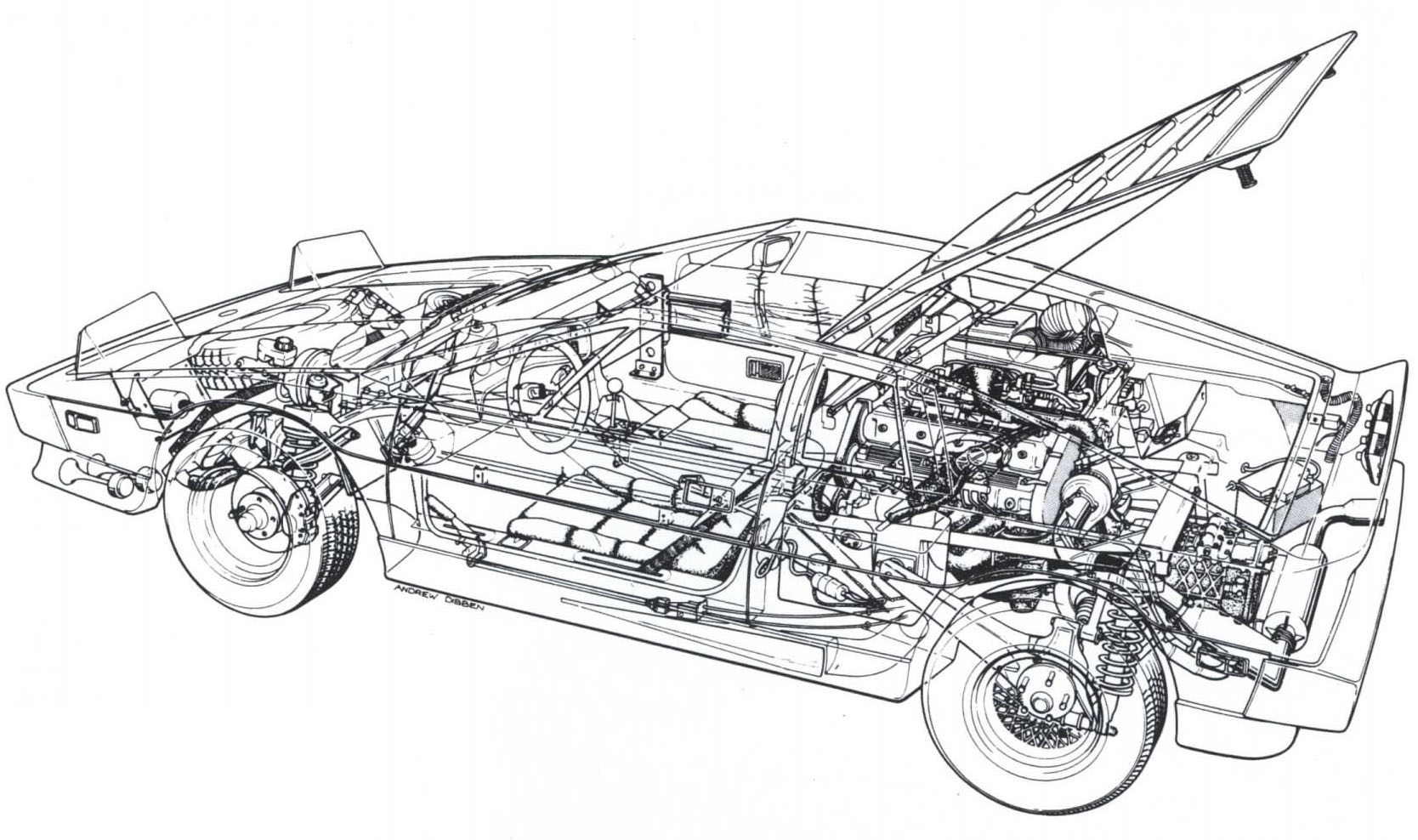
A cut-away drawings of the Lotus Turbo Esprit
The gearchange of the Citroen five-speed gearbox equipped with Lotus
ratios is excellent in normal driving with the exception of the
fifth to fourth change which is a little vague. It is a gearbox
which does not like to be hurried too much, but it proved trouble-free
and well able to cope with the power output during the test period.
A new gearbox casing has been introduced along with a revised gear
linkage. This latter modification was necessary to stop the linkage
fouling the new rear calipers. The gearchange has also been shortened.
Entering and exiting the Esprit is not the easiest of tasks; one
does not expect it to be that simple, but it is made more difficult
by the limited amount of door travel and the wide sills which have
to be negotiated while turning and lowering oneself into the seat.
At the same time, it is also advisable to duck to avoid the doorframe.
An interesting touch in this area is the lie-flat handbrake mounted
on the driver's right. Of Lotus design, it is intended to make the
difficult entry and exit process just a little bit easier.
The luggage area is still a joke, though much better than before.
Whereas there was only a tiny compartment behind the engine compartment
due to the engine croachment of space-comsuming body struts, these
have been redesigned into the back panel with a resultant increase
in oddment space. Lotus claims that a set of golf clubs can now
be carried in this compartment. Under-bonnet space remains at a
premium with only enough for the occasional squashy bag.
An Esprit owner, however, is unlikely to be concerned with whether
or not he can fit 6.4 cu ft of suitcases under the bonnet; a change
of underwear for the driver and passenger and an open road are all
that should be required.
Performance and Specification
Engine: longways mid, rear-wheel drive. Alloy head & block.
4 cylinders in line, wet liners, 5 main bearings. Water cooled,
electric fan. Bore: 95.29mm, stroke: 76.20mm, capacity: 2174cc.
Valve gear: 2 ohc, 4 valves per cylinder, toothed belt camshaft
drive. Compression ratio: 7.5 to 1. Breakerless electronic ignition,
2 Dellorto 40 carburettors. Garrett T3 turbocharger, boost pressure
8psi (0.5 bar). Max power: 210bhp @ 6250rpm. Max torque: 200 lb
ft @ 4500rpm