




Road & Track Magazine - Road Test 1988
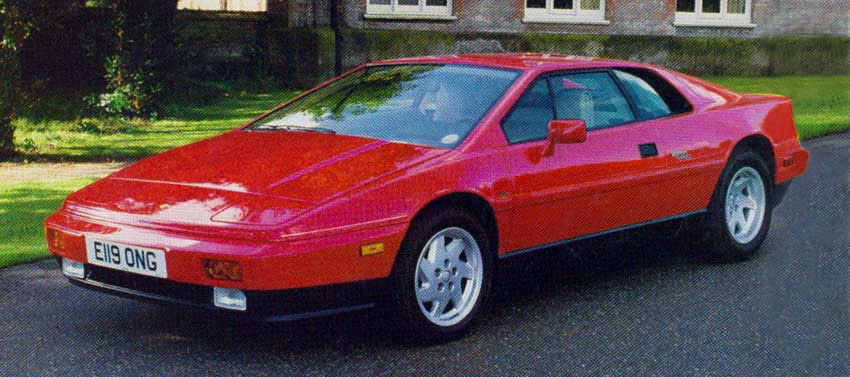
Lotus Esprit
Turbo
A new lease of life for the veteran exotic
By Peter L. Albrecht
Photos by the Author
The Lotus Esprit has been around for quite a while. The car has
weathered several oil crises, has seen the American speed limit
imposed and, ahem, modified, and has come through none the worse.
Although the plant as the old World War II airfield of Hethel,
near Norwich in East Anglia, doesn’t exactly resemble the
latest exercise in robotics, the small factory is proud of it’s
craftsmanship and the limited-production nature of the products
which are quite literally molded into shape in the hangers that
once housed B-24 Liberators of the 389th Heavy Bomb Group.
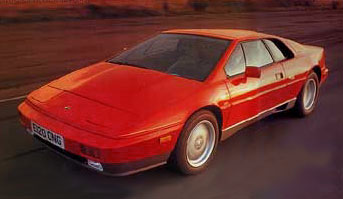
For 1988, Lotus introduces an all-new body for it’s flagship.
The original body, designed by Gioggetto Giugiaro at Colin Chapman’s
request on a modified Lotus Europa chassis, had that folded paper,
automotive origami styling so in vogue in the Seventies, best
exemplified by Giugiaro’s design of the original VW Scirocco.
While many a more recent design has aged more rapidly, the Esprit
styling has stood the test of time very well, but is now beginning
to look just a bit dated. To inject some more life into the design,
and to campaign in the American marketplace with renewed vigour,
Lotus has designed an all-new body shell for the old mechanicals,
still attached to the same steel backbone, but this time to body
is an in-house design by Lotus’ own Peter Stevens. The body
is made by Lotus’ patented VARI ( for vacuum assisted resin
injection) method, allowing greater strength and better consistency
than the old bucket and brush hand lay-up methods.
The new body exhibits a smoother, more rounded shape, the rear
buttresses have been cleaned up, combustion-air inlets have been
blended in behind the rear quarter windows, and a sheet of smoked
glass open at the bottom for ventilation, has been added to improve
aerodynamics, replacing the sopped backlight and black louvers
of the earlier models. Also gone is the tacked-on appearance of
the skirts and bumpers: the new car has a much more integrated
look. Not surprising, because the older body had to change over
the years to meet changing times and performance levels. For example,
in the original road test (R&T July 1977) the Esprit ran 0-60
mph in 9.2 seconds, the quarter mile in 17 flat, and topped out
at 120 mph. The Turbo, as last tested (June 1986) did 0-60 in
5.6, the quarter in 14.3, and had a top speed of 152. That sort
of top-end performance will exact its toll in aerodynamic changes,
hence the somewhat cobbled-up look of the last of the Giugiaro-based
Esprits.
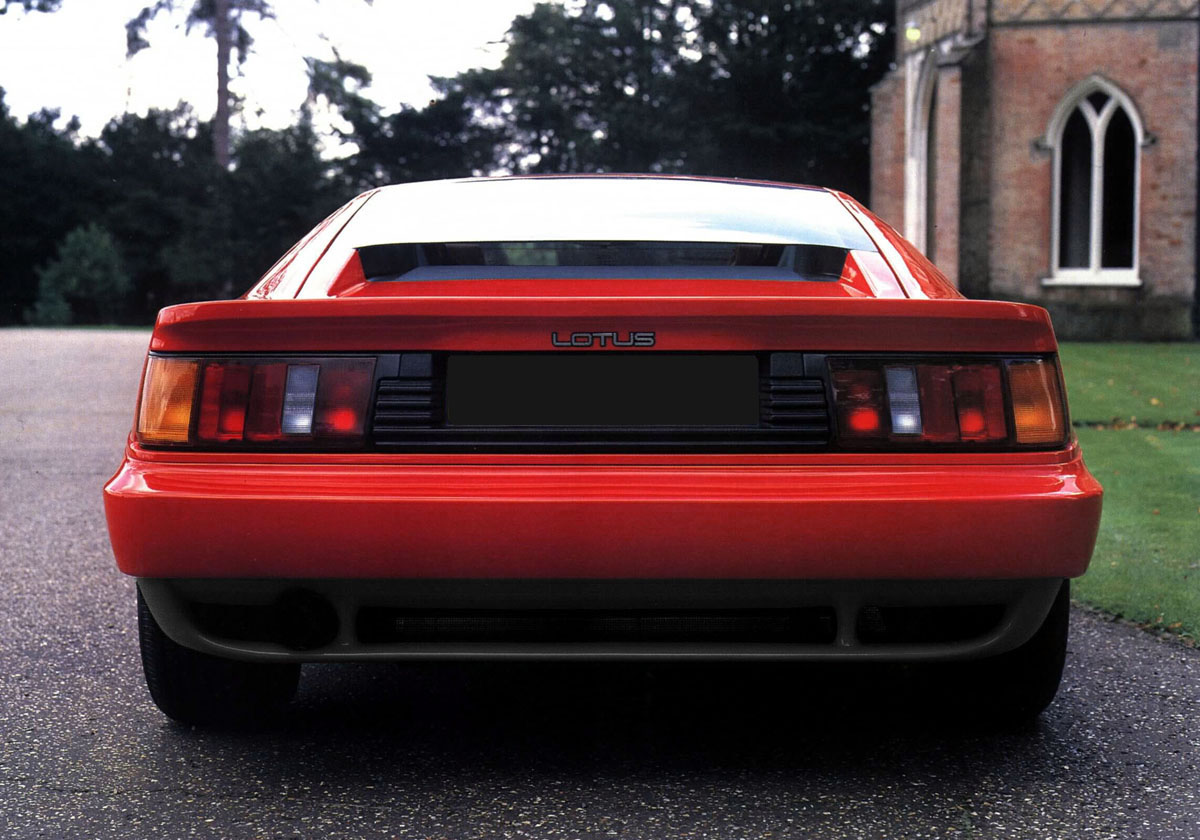
The new car should be faster still, thanks to its improved aerodynamics.
Lotus claim a Cx of 0.33 to 0.35 compared will well over 0.40
on the older body. Much of the car comes from parts bins, but
that doesn’t detract from the grace of its design. The taillights,
for example, are taken directly from a mass-produced car, but
work well in this design.
Moving on into the interior, one meets the expected Connolly hides,
done as only the English (and yes, the Italians) can do them.
In the new Esprit, a subtle 2-tone effect is used, with two welts
of slightly contrasting colors forming a stripe running transversely
across the seats and door panels, again making an integrated design
statement. The shapes are familiar to those accustomed to the
more recent models of the old Esprit, but, again like the exterior,
exhibit a cleaner, rounder, more thoroughly thought-out look.
The seats are (finally!) adjustable for rake. The instruments
are housed in a binnacle which also contains pushbuttons for the
road lights. Binnacle and dash are thoughtfully done in black
leather to minimize annoying reflections in the windshield.
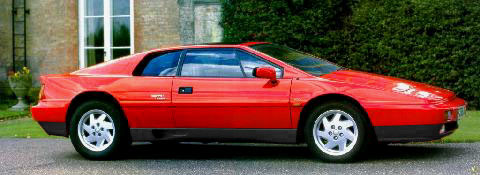
One thing I didn’t like, though, was the instrument panel
layout. The instruments could be made a little larger and legible;
the present small tach and speedometer are split by a boost gauge
which could be located in some less important place. The smoked
rear fairing detracts from the view through the vertical backlight
behind the seats, the top half of the picture being considerably
darker than the bottom, but one quickly gets used to this. The
horn actuation, also, will require some getting used to: it’s
on the left-side steering column stalk. A hot steering wheel hub
would be a better solution; in fact, the wheel appears to have
such an area, but it’s non-functional. The wheel buy the
way, is a traditional 3 spoke design with nice indications to
hook one’s thumbs into; many a carmaker has gone to trendier
but less effective designs. Another feature I would have liked
to see is a deal pedal: admittedly the wheel well intrudes quite
far, but there is still enough room between it and the clutch
pedal that needs to be filled. The side mirrors are still located
aft of the A-pillars; locating them at the base of the pillar
would improve visibility and soften the appearance of the gusset
located there.
The mid-engined, double-overhead-cam 16-valve four fires up readily,
as is to be expected with Bosch K-Jetronic. This car requires
very little familiarization with pedals and shifter to make the
driver feel quite in control; in fact, I was thrown in at the
deep end, driving the U.S. specification pre-production car at
high speeds, on the “wrong” side of the very narrow
English country lances, with oncoming trucks – BIG trucks-leaning
over into my lance. The best gauge of how far I could go to the
left was the sound of bushes whacking against the bodywork. Yet
the Esprit Turbo gave me a feeling of complete control over its
every action.
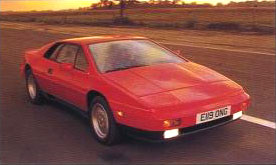
Over-steer is there at the limit, but it’s not killer over-steer;
one can pull the car back from the brink, it’s controllable
at the limit and very forgiving for such a high-effort corner,
the rear end will come out, as if to say “Why did you do
that? Make up your mind!” but it can be caught by application
of opposite lock. At speed, wind noise is present but not particularly
obtrusive. If the revs are kept up, turbo lag is not noticeable.
The shifter, controlling the Citroen-built transmission (for U.S.
cars only; the rest of the world gets a Renault box) is still
on the heavy side at low speeds and the reverse lockout still
requires a hefty tug upwards, but at speed the shifter and clutch
harmonize very well. The body impacts a very solid, relatively
rattle-free feeling, thanks to detail engineering in the structure
and the greater stiffness of the new design. In short, the car
exemplifies the handling which one expects of a car carrying the
Lotus badge. If the Esprit had a downside, it’s the engine.
Not that there is anything seriously wrong with it, mind you,
the power-plant is responsive (when it’s on boost) and has
a lovely exhaust note. It’s just that for a base price of
$62,500 ($69,500 for the commemorative edition) buyers may reasonably
expect to get a least a V6. I wouldn’t be at all surprised
if Lotus is charting some major changes in the engine room.
The new Esprit will be carried over the road by its predecessor’s
suspension. Although Lotus is the leader in active suspension
technology, the systems are not yet production ready (cost is
a stumbling block). Lotus defines active suspension as one in
which energy is added to the system. Other makers have adaptive
suspensions, with control of damping or spring rates or self-levelling,
although several other carmakers’ R&D labs are now playing
catch-up.
Lotus had big plans for the future: the active suspension project
M300 intended to compete square in the same class as the ultra-exotics
such as Lamborghini, Ferrari and Porsche’s 959; and project
M100, a small, more affordable sports car. Meanwhile, we have
the new Esprit Turbo. An exotic by any standards, offering high
performance in a limited-production car, Lotus hopes it will re-establish
the company’s image in the U.S. as a maker of fine sporting
machinery and pave to way for Loti of the future.