





Fragile
vs EGO
It's hard to imagine rational BMW and brilliant but fragile Lotus
competing head-to-head.
That the M1 and Esprit had so much in common is a bigger surprise.
Classic Cars, August 2004
words by Tony Dron, photography by Malcolm Griffiths
They share
so much, this pair of mid-engined two-seaters, it was irresistible
if a bit cheeky to put them together. For starters, both appeared
in 1978 and both these wedgy dream machines were styled in Italy
by Giugiaro. All right, the cheeky bit is that the German car
is easily the quicker, as well as always being by far the more
expensive machine. The BMW was a good old homologation special
costing the best part of £27,000 at the factory gates in
Germany. Makes you wonder whether Lamborghini, contracted to build
the M1 for BMW, failed to deliver for BMW because they realised
it was better than the Countach. But that would be uncharitable.
Lamborghini had all sorts of business problems and BMW had to
take the project back to Germany.
On the other hand, the Lotus was nothing more, nor less, than
company boss Colin Chapman's notion of the perfect sporting road
car of its time and he sold it for £11,754, including Car
Tax and VAT, in the UK. Yet the fundamental idea – to produce
an ultra-modern sports car based on the latest racing thinking
– was the same in each case.
So, more than a quarter of a century down the road, does the popular
notion of fragile Norfolk ingenuity matched against solid Bavarian
precision hold true? Will one of them emerge as a more characterful
winner, a more desirable classic to own now, in the 21st century?
Driving them both on the same day produces the odd surprise.
Which, for example, do you suppose is the more comfortable? I
had imagined the BMW would win hands-down on that score and I'll
be most of us would expect that. Well, it just isn't so. The unpretentious
interior of the M1, famously designed to match the company's saloon
cars of the day, shares its instruments and switchgear with contemporary
3 series and 7 series models. It has a certain stark appeal which
many find attractive, but I had forgotten about he headroom. You
really need to be about 5ft 8in tall to be comfortable in the
BMW and the lack of support, worsened seriously by the inadequate
headroom, can spoil the driving pleasure in an otherwise magnificent
machine.
The
truth is I had to remove by size 12 shoes to drive both cars,
but for different reasons. With shoes on in the BMW, my right
knee got between the gearlever and the steering wheel when selecting
reverse or first; in the Lotus, the small pedals are simply very
close together and you need special footwear, something like racking
boots – or no shoes at all – to drive it safely. That
said, I knew I would fit into the Esprit as I have driven many
of them down the years, but I had forgotten how comfortable they
are once you have wriggled inside. The Lotus has a more laid-back
driving position than the M1 but I felt properly supported in
the Lotus and would have no problems driving it all day.
Such things are serious issues only to tall freaks like me, so
enough said. What matters more is how the two cars match up for
looks, style and driving experience. We could not have found two
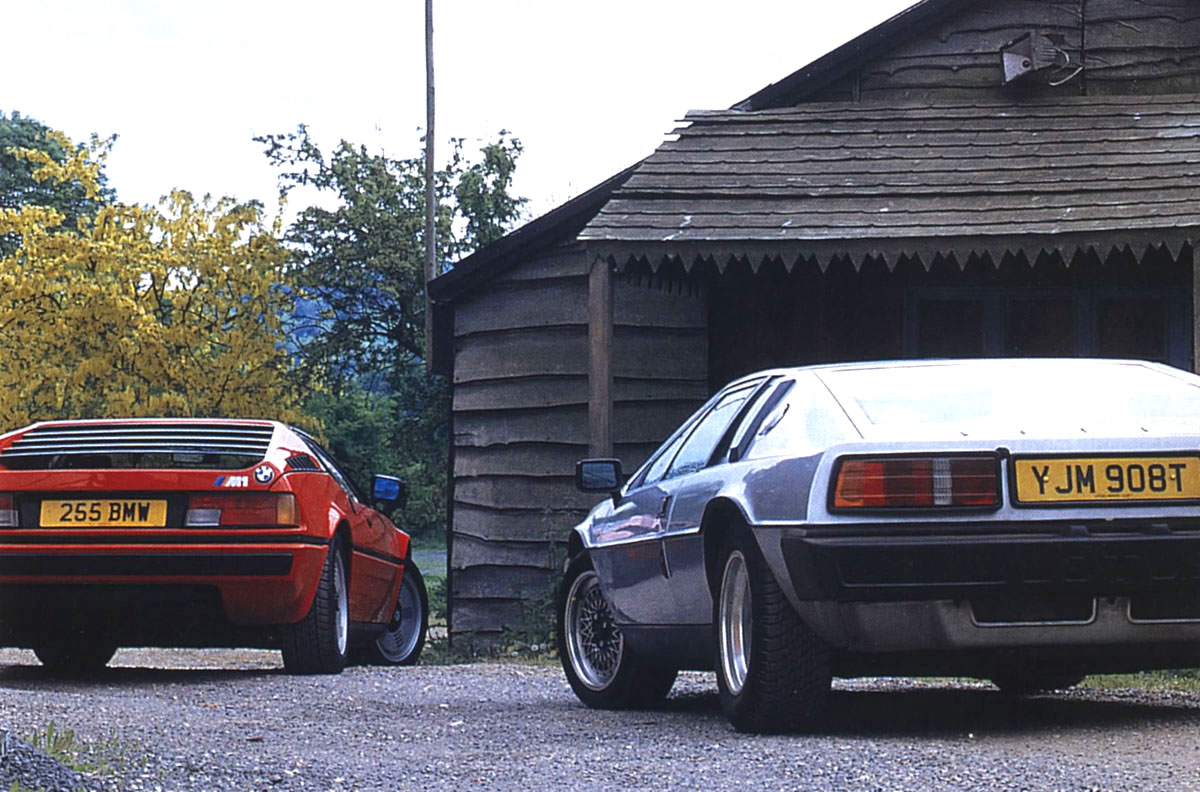
better cars for that. The M1 belongs to BMW Great Britain and
it's a perfectly-maintained original with only 23,000 miles covered.
The Lotus has had a more active life but it, too, is lovingly
maintained by devoted owners Barbara and Arthur Clarke, the events
organisers in the Midlands for the Lotus Drivers' Club. No excuses
needed here for either of these two great cars. They're both as
good as new.
As for looks, both are head-turners. But the M1 seems to attract
slightly more attention, probably because it is so rare. It's
a masterpiece of styling, that glassfibre body, being muscular
yet dignified from every angle and still, with its kidney grille
at the front and recognizable rear lights, very obviously a BMW.
The Lotus, with its sharply-chiseled look, is another widely acclaimed
classic Giugiaro design. They're different but both score very
high points for style.

Inside,
the contrast between these two cars could not be more extreme.
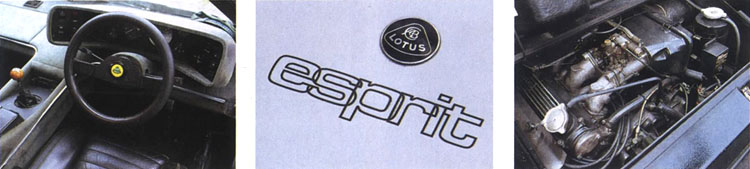
While the BMW does its best to look like a stern, respectable
Bavarian business machine instead of the racer it truly is, the
Lotus is plush and carries that 'Thunderbirds Are Go' style instrument
pod in front of the driver's eyes. Both interiors command respect
but I reckon this sort of car should be partly about fun and I
prefer the Lotus for that reason. Personal choice is all-important
here, however, so you are allowed to disagree.
Based on the six-cylinder 635 block, the BMW's engine is magnificent.
It sounds great and it delivers awesome performance by 1978 standards.
Remember this is only the 'cooking' version. producing 277bhp,
but it is more than powerful enough for road use. Even today,
the standard M1 is still a very fast car, capable of 100mph in
third gear – a speed at which it is merely ambling along.
With maximum torque at 5,000rpm, you need to change gear quite
frequently to get the best from it, but if you're not in the mood
for that you can leave it in a relatively high gear and it still
performs well. The full Group 4 racer, with 470bhp, must have
been some machine, not to mention the Group 5 racer, with a turbocharged
3.2-litre engine producing more than 850bhp.
The
Lotus engine, of course, is a more modest and much smaller four-cylinder
unit. While this sounds less impressive on paper, Chapman was
always looking for low weight as part of the overall concept of
his cars. A big, heavy engine has to be carted around the corners
along with everything else in the car. With a relatively small,
efficient engine, he aimed to preserve the nimble handling that
was his specialty. In that context, the specification he chose
for the Esprit S2 still makes good sense.
The downside of the Lotus engine is that it's boomy and noisy.
I can live with that because it's not the kind of boom that gets
on your nerves. The main sound on wide throttle openings is a
lusty roar, a deeper note than you might expect, and I rather
like it. Switching back to the M1, however, there's no denying
that the BMW engine is a superb and delightful thing to have behind
your back, thrusting the car along.
Changing gear with the dogleg-first ZF box in the BMW is fine
once you get used to its rather odd feel. The direction in which
the lever has to be moved from second to third, for example, doesn't
feel like the straight line you'd expect. the entire transmission
is obviously immensely tough, but the clutch travel and gear lever
throws are both long. The Lotus gearchange feels lighter and more
switch like, giving the feeling that smooth changes can be achieved
much more quickly.
The mid-engined design of these cars gives that typical, almost
magic-carpet ride. It's just not sufficient to say the handling
of both is safe and reassuring: it's outstanding in each case,
superior to most other mid-engined machinery. Without all the
safety kit and other items modern cars need to comply with complex
regulations, these two are both lightweights by high-performance
road car standards. They don't have ultra-low profile tyres, nor
excessively wide wheels, yet their roadholding ability is still
high.
When you start swooping through fast, open bends in the S2, you
can feel what Colin Chapman was on about. The Esprit is light
to handle, fast in its steering responses yet wonderfully stable
and surefooted. Eagle-eyed readers may have spotted the 1980 Essex-model
wheels fitted to this car. Arthur has been unable to find tyres
in the right size for his original wheels and has been forced
into this temporary compromise. I'd be tempted to leave it like
that because the car feels fabulous just as it is. I really enjoyed
my brief drive in it, a moving reminder of Colin Chapman's visionary
notions of how to create a high-performance car.
On a fast, open circuit, of course, the more powerful M1 would
see it off with ease. It, too, is extremely reassuring when you
start to mean business in the corners. It's only six inches longer
than the Lotus but, thanks to its much larger engine and consequently
more massive components everywhere else, it is 30 per cent heavier
and it feel correspondingly less nimble. In tight corners, I suspect
the Lotus would take its turn to run rings around the German car.
In a car park, for what it's worth, there's no contest. This is
where you realise that the M! really was designed for racing;
the turning circle is a huge 43ft and it's hard work in such tight
spaces. Only then do you notice it has no power steering. Parking
ability is irrelevant to a racing car so this is not a fault,
simply something to bear in mind if you're thinking of getting
one.
Although cars like these are not built for shopping, Barbara and
Arthur did once do a big shop in their local supermarket, forgetting
they'd taken the S2 and not Arthur's Jaguar. They managed to get
the contents of a piled shopping trolley into the S2 but it would
take half an hour to explain how they did it. You really don't
need to know: just take it that both cars have reasonable luggage
space, but I suspect the BMW protects it better from heat in the
back and water in the front.
Is the Lotus reliable? Arthur has had only one really bad experience.
When he bought it, the cambelt had just been changed, which seemed
good and proper, but what he didn't know was that the tensioner
hadn't been replaced. Result: failure and a bill for about £1,762.83.
If I remember right. Since that engine rebuild the car has been
reliable over thousands of miles.
What about that fickle thing: how much? Back in 1978, the BMW
started off at about three times the value of the Lotus but it
leapt away and is now worth about eight times what you have to
pay for a decent Esprit S2. If you're not that rich and you're
looking for simple driving pleasure from this kind of car, the
choice is obvious: get a Lotus Esprit S2. In some ways it's actually
better to drive.
But life is not that simple. Both are are items, especially the
M1, and let's face it, this particular M1 is unique, an unspoilt
item. It's not for sale but on the open market there would be
an unholy scramble for it. Without consulting anybody on the matter,
I suggest its history and condition would make it fetch a great
deal more than £50,000.
Serious BMW collectors would kill for it, I'd say, and this fabulous
example deserves to be taken almost that seriously.
1978 Lotus Esprit S2
Engine 1973cc, in-line four cylinder, dohc, four valves per cylinder,
two Dellorto DHLA 45E carburettors Power and torque 160bhp@6500rpm,
140lb ft@5000rpm Transmission Five-speed manual, rear-wheel drive
Brakes Discs front and rear, servo assisted Suspension Front:
independent, unequal wishbones, coil springs, telescopic dampers,
anti-roll bar, Rear: independent, lower transverse links, fixed-length
driveshafts, semi-trailing arms, coil springs, telescopic dampers.
Steering Rack and pinion Weight 2229lb (1011kg) Performance Top
speed: 130mph; 0-60mph: 7.7 sec Cost new £11,754 Value now
£6,000
1978 BMW M1
Engine 3453cc, in-line six-cylinder, dohc, four valves per cylinder,
kugelfishcher-Bosch mechanical fuel injection Power and torque
277bhp@6500rpm, 239lb ft@5000rpm Transmission Five-speed manual,
rear-wheel drive Brakes Ventilated discs front and rear Suspension
Front: independent, double wishbones, coil springs, telescopic
dampers, anti-roll bar, Rear: independent, double wishbones, coil
springs, telescopic dampers, anti-roll bar. Steering Rack and
pinion Weight 2865lb (1300kg) Performance Top speed: 162mph; 0-60mph:
5.6 sec Cost new £26,810 (at the factory in Germany) Value
now £50,000-plus (see text)