




GREAT
BRITISH SPORTS CARS
Lotus Esprit
Classic Car May 1996
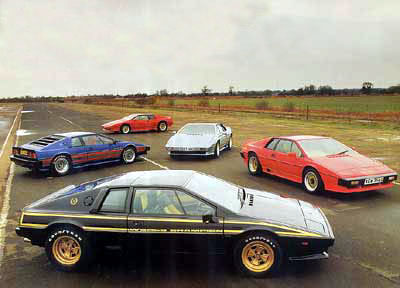
Colin
Chapman ‘s flair and vision produced the remarkable Lotus
Esprit 21 years ago.
Though impaired by cash problems, it grew into one of the true greats,
says Tony Dron
As
a driver, it’s hard not to love this car in true Lotus tradition
it became a great driving machine, with extraordinary roadholding
and an unusual subtlety of handling. There’s a strong feeling
of real racer about it.
It’s incredible that it came into being at all In the early
Seventies, Lotus dropped all its established models to move upmarket
with the totally new Elite, Eclat and Esprit, all to be powered
by new all-Lotus engines. The idea was to produce a range of supercars
at bargain prices by employing modern manufacturing methods.
As Lotus got stuck into the practical work of this very ambitious
new era in its history, it became increasingly clear that the new
generation of cars would have to cost much more than planned. Meanwhile,
income was interrupted and, with the general economy far from healthy,
Lotus was frequently on the edge of financial disaster through those
years. Only the determination of Colin Chapman and his team kept
the company alive. After launching the Elite and Eclat in 1974 and
1975, they had great difficulty in finding the means to turn the
third new model, the Giugiaro-designed Esprit, into a practical
road car but the Italian stylist’s personal commitment helped
to keep the project moving.
Against the odds, they made it For once, a fantasy show car was
put into production: Giugiaro’s styling exercise appeared
at the 1972 Turin Show and the production version was unveiled in
late 1975. We know now that early cars were inadequately developed
but the Esprit was on the road, Effective development and inspired
restyling over the years allowed it to endure.
There’s more to this than looks. A key point of the lasting
appeal of the Esprit must be the mixture of passenger car engineers
and race team personnel who worked on it. This produced a remarkable
machine — but not, for sure, without some (well glossed over)
internal technical arguments in the early years.
The Esprit had its faults but from the start it had the vital ingredient
of being exciting both to those within the factory and to the world
outside. In the gloomy days of the mid-Seventies it was invigorating
to see such a fresh, boldly executed, utterly modern sports car.
It was very close to Colin Chapman’s heart: he was determined
to produce it, whatever problems Lotus faced. When DeLorean wanted
to buy Lotus, the other -models were discussed but the Esprit was
always to be excluded so that Chapman could continue to make it.
By the late Seventies, however, Lotus cars were selling reasonably
well and the Formula One team was on top of the world. It’s
just a pity that Chapman ever met John DeLorean, let alone got involved
in saving his ludicrous 2 motor car from the perdition it deserved.
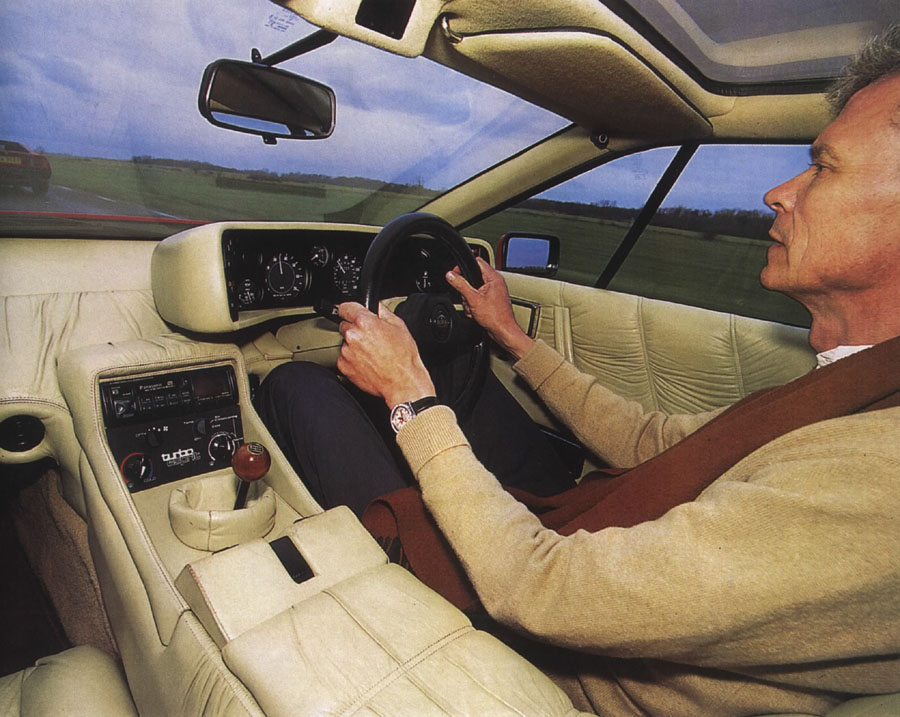
‘Lofty’
Dron does fit into Giugiaro Esprit, but only just: here he is at
the wheel of Chris Cole’s smart Turbo.
There’s much more room in post-1987 cars
BEHIND THE WHEEL
Before anything else is said, let’s be clear about one thing
the Lotus Esprit became one of the greatest drivers’ cars
ever made for the road. That is the simple truth of it. Early Esprits
were sensational but it wasn’t as easy to put a motor show
dream car into production as Colin Chapman probably thought. The
essentials were fabulous but a part-finished prototype car was put
on the market to get some money back before the company went under.
The dream was strong enough to make you want to love it but it was
a while before Lotus managed to eliminate the nightmare element.
When the new Esprit first arrived it was considered interesting
but not fast enough to deserve the tag of ‘supercar’.
The lack of performance is often overstated: to put it in perspective,
the standstill to 60mph accel-eration time recorded in Motor’s
Road Test of 1977 was 7.5 sec and, though maximum speed was not
measured, the magazine stated: ‘Over 130mph is probably feasible.’
True, these are not supercar statistics but they’re hardly
slow. Performance figures for the cheaper Triumph TR6. regarded
in the Seventies and since as a fast and powerful ‘real man’s
car’, were 117mph and 8.5 sec. Barry Ely’s Commemorative
S2, seen here, certainly did not feel slow on the road to me.
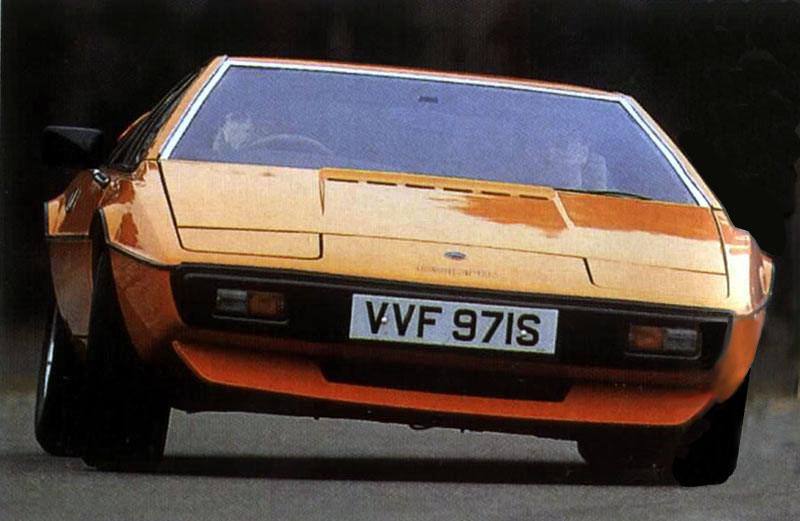
Lotus Esprit S1
Our
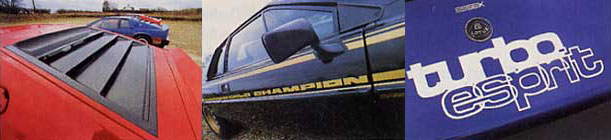
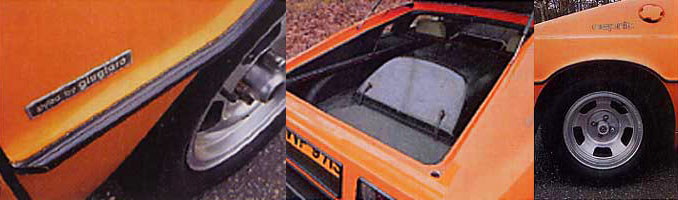
cover car, John Roberts’ S1 Esprit; note very Seventies trim
and Giugiaro badge. Most S1 cars went to the US. Engine cover was
only fitted to Series 1 cars; Wolfrace alloy wheels were also unique
to the early Esprit.
The earliest Esprits had phenomenal roadholding and simply astonishing
traction but the steering feel was below Lotus standards: worse,
the noise was enough to drive you mad, and there were several other
problems. But few British drivers ever experienced an SI, as virtually
all of them went abroad. Fortunately, the energy within Lotus was
such that the Esprit rapidly became good enough to own and live
with.
Performance was steadily improved: the normally aspirated 2.2 achieved
0-60mph in 6.5sec, with an estimated 135mph top speed: and the original
Turbo managed 5.6sec, with a claimed 152mph maximum.
The Esprit was greatly improved but some inherent faults remained
even with the introduction of the S3 and Turbo: these were mainly
bad visibility, especially to the rear, a poor heating and ventilation
system (despite many attempts, it took a very long time to get it
right), reflections on the screen (worse with lighter interiors),
small pedals which were too close together (excellent if you choose
the right shoes before getting in) and lack of headroom for very
tall drivers. Unusually elongated folk are more comfortable in the
earlier cars, which don’t have that extra ventilation outlet
by the left knee. Drivers of normal human dimensions find Esprits
comfortable, however, and while there are more practical and civilised
supercars from that era, for pure driving pleasure the Esprit is
a match for any and better than most.
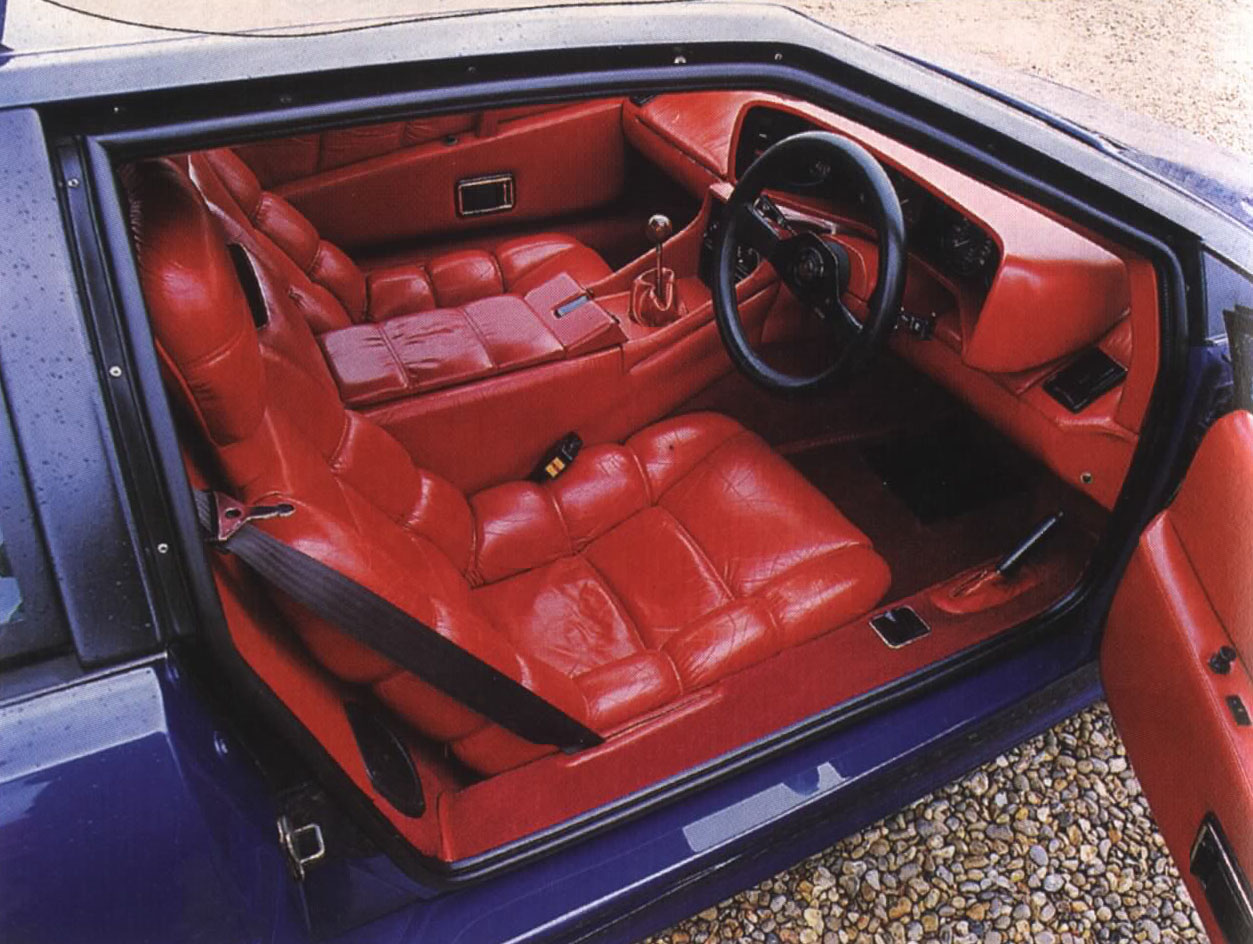
Lotus Esprit Essex interior
The
experience of handling a mid-engined car with its engine mounted
longitudinally is rare enough: in an Esprit, the sense of balance,
surefootedness in the wet and feeling of control when driving fast
are strong sources of pleasure. You need to be something of an expert
to explore its high roadholding limit — but only because it
is so high. The ride is unusually good, too: with no lump of engine
ahead of you, it’s uncanny the way the front wheels handle
bumps and irregularities in the road. Lotus was always superb at
showing that lightweight, pure sports cars can be made to ride well
and the Esprit is an outstanding example.
Try to put aside any prejudice against four-cylinder engines. The
brand-new 1996 V8 unit looks magnificent and will, no doubt, lift
the Esprit into an even higher league — but, equally without
doubt, it will cost rather more as well. The four-pot engines in
all previous Esprits, normally aspirated and turbocharged, are admirably
light, efficient and enjoyable to use, if noisy.
Furthermore, the Turbo has unexpectedly excellent torque from low
rpm, with no sense of a ‘step’ in the curve as the turbo
‘comes in’; yet all Esprit engines are happy at high
engine speeds, too. Before electronic engine management was mastered
the quickest Turbos were rather ‘fussy’ but all blown
Esprits are firmly in the supercar performance league: the early
Essex of Paul Dewey, Graham Bedwell’s dry-sump model and Chris
Cole’s slightly later car all reminded me of that fact. They
are real road rockets.
When we were invited to visit the Lotus factory, to photograph the
cars in an appropriate setting, we were joined by Lotus engineer
James Grantham with his LHD Esprit from 1986, originally a US-spec
test car. He bought it some years ago and converted the engine to
UK spec. It’s one of the first with the Renault gearbox. which
replaced the old SM unit; it also has outboard discs. James says:
“It always amazes when I get back into it and drive. There’s
so much in reserve.
He’s right. All the owners agreed that you get used to the
restricted visibility and other negative points listed in the road
tests. Once you get behind the wheel it’s genuine supercar
pleasure at bargain price. Everything that really matters is evident:
serious performance. great steering, incredible roadholding. powerful
brakes with good feel, an unexpectedly good gearchange and the lithe
feel of a well-sorted racer. It’s not a ‘sensible’
car: it’s an escapist’s dream, and a fine one, too.
Fuel consumption is good for a Seventies car of such immodest performance:
in the region of 18-23mpg under hard use but 25-30mpg is easily
achievable. The normally-aspirated models. naturally, tend to be
the ones at the less thirsty ends of these ranges.
Don’t worry about the smell of resin remarked on in some road
tests. The bodies have fully cured now and there’s no trace
of any such odour. With the new body of 1987, visibility, headroom
and other longstanding flaws were substantially dealt with. It was
a successful reworking of the classic Esprit, recognised as one
of the greatest road driving machines. I it again... It’s
true.
DESIGN
Lotus
racing cars had long been mid-engined when the Europa appeared as
the first such L0otus road car in 1966. The idea was to offer an
exciting level of technology to enthusiasts at well below supercar
prices. The basic design of the Esprit, with a steel backbone chassis
and in-line mid-engined layout, may have been broadly similar but
the overall concept was quite different. Aiming for the big league,
the Esprit was therefore 13ft 9in long and 6ft 1in wide, making
it 7in longer and no less than 9in wider than the Europa. Furthermore,
the exotic Esprit was styled by the rising Italian star, Giugiaro.
The Esprit’s chassis differed from the Europa’s in that
the backbone stopped behind the seats. In place of ‘tuning
fork’ extensions to carry the engine, the Esprit chassis was
joined to a tubular structure at the rear. The rear suspension,
with fabricated radius arms, single lower links and fixed-length
driveshafts, was partly mounted on the gearbox. It was low in weight
but it transmitted noise and vibration to the interior. Spherical
joints were used in the rear suspension in the first few cars but
that proved unsatisfactory: bushes more suitable for road use were
adopted and all the cars were subsequently converted. Double wishbones
were used at the front, which was based on Opel Ascona parts.
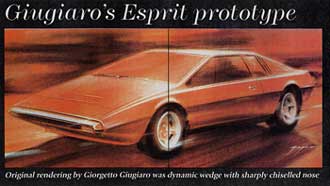
Giugiaro's rendering of the Lotus Esprit
Long-term
supplies of the so-called transaxie gearbox/final drive from the
SM were secured from Citroen; a good move, as Lotus could not have
afforded to develop its own transmission. Crafty machining enabled
the inboard rear brakes to be fitted, too; the discs were solid
all round, with no servo-assistance at first, though that was changed
before long.
Lotus built its own engines at last, moving upmarket and away from
the old kit car image. The Esprit was always intended to be offered
with a choice of in-line four and V8 engines. For financial reasons,
the V8 Lotus engine did not materialise until this year. By the
time the Esprit arrived, the slant-mounted four-cylinder, double-overhead-camshaft,
aluminium engine was well proven in earlier cars. As first installed
in the Esprit in 1,973cc form, it ran on twin Dell’Orto carburettors
and produced 160bhp at 6,200rpm, with maximum torque of 140lb ft
at 4,900rpm. Although this equated to the efficient little motor
delivering an impressive 81bhp/litre, it could hardly be expected
to be enough to enable the Esprit to stand alongside the Ferraris,
de Tomasos, Lamborghinis, Maseratis and Porsches that it had been
intended to challenge.
Tony Rudd, Lotus’s engineering director at the time and one
of those charged with turning the Esprit from showtime dream into
practical reality, recalls running a prototype Esprit V8 on long-term
test in the Seventies: “Four litres and over 300bhp really
lifted the car but it tended to demolish second gear or break the
diff. When Lucas demanded payment for fuel injection development
we tried Webers but suffered fuel surge in corners.” Lotus
just didn’t have the money to finish the job: with reluctance
it had to drop it in 1979 and pursue an alternative path to true
high performance. By then the car had been in production for three
years.
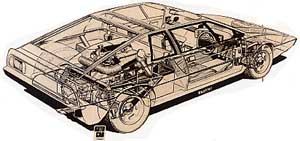
Cut Away of the Lotus Esprit S1
Esprit
bodies were made in two halves, joined at the waistline, but further
problems in 1976 had meant that the early ones could not be made
by the celebrated vacuum (VARI) system and were laid up by hand.
When the factory was able to go over to VARI, the Esprit put on
unexpected weight and, Tony Rudd recalls, “There was a bit
of a lull while that was sorted out.”
The first big change came with the S2, announced in August, 1978.
The main features were wider wheels, a bigger radiator with improved
airflow (but that took some months to reach production) and ducts
behind the rear windows (nearside fed the carb and demisted the
rear window; offside cooled the engine bay).
An engine enlargement to 2.2 litres, announced in May 1980, increased
the peak torque to 160lb ft at 5,000rpm and gave a useful performance
improvement. Also announced in 1980, after the forced abandonment
of the V8, the Turbo brought real performance at last. This engine
had been developed successfully and more cheaply in parallel with
the ill-fated V8: the Garrett turbocharger drove through smaller
twin Dell’Ortos and the fully redeveloped engine produced
210bhp. Early Turbo engines had dry-sump lubrication.
The rest of the car was substantially re-engineered, too, and the
normally-aspirated Esprit S3 of 1981 shared the main benefits of
this. There were changes to the appearance but the most important
developments were under the skin: a galvanised chassis with a wider
front box section and suspension mounting points; new engine mountings
to reduce vibration; pure Lotus parts to replace the Opel elements
in the front suspension; improved rear suspension with lower wishbones
and a new upper link. Designed for the V8, the production Turbo
was, frankly, over-engineered by Lotus standards. Torsional rigidity
was well up, vibration was down and there was a claimed, and much
needed, 50% reduction in noise inside the car. Relieving the driveshaft
of having to function as the upper rear suspension link gave an
additional reduction in transmitted harshness.
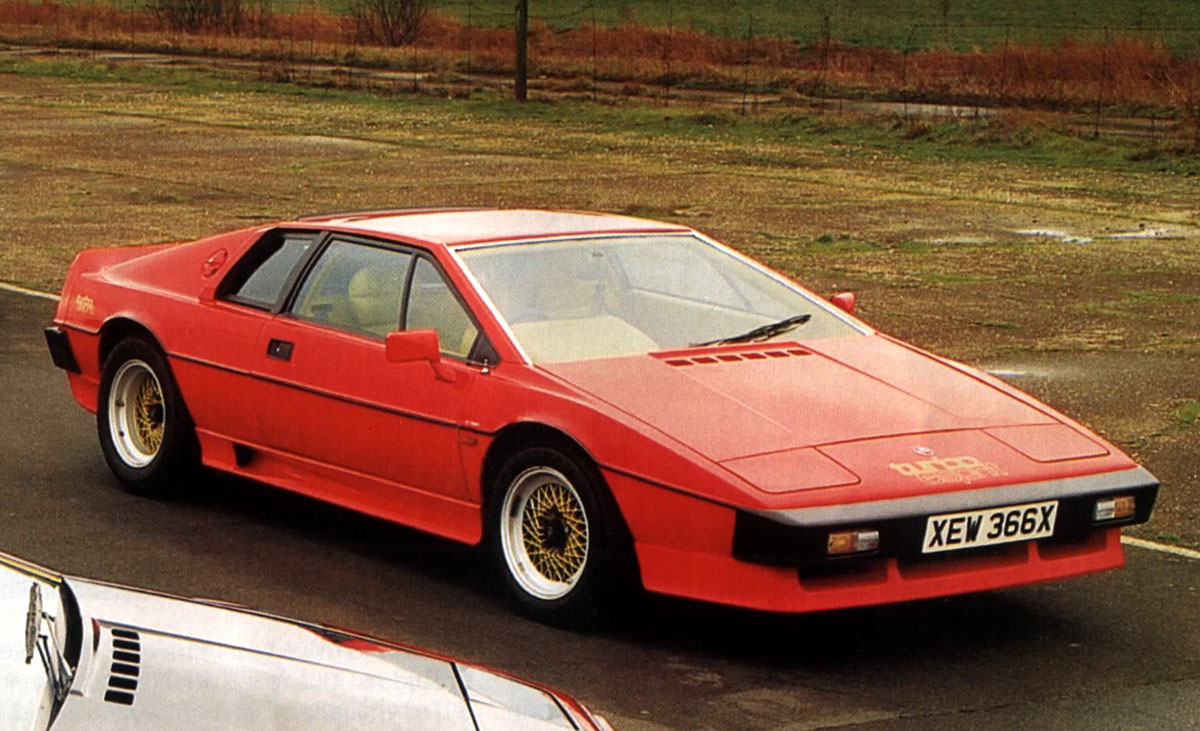
Lotus Turbo Esprit
These
changes, lavish new trim and luxuries such as electric windows all
cost money, so that, at £20,900, the Turbo Esprit was actually
more expensive than the rival Ferrari 308GTB, Porsche 911 SC Sport
and the rest — but it was also, at last, the quickest among
them.
Maximum power went up to 215bhp in 1986 when the High Compression
turbo engine was introduced but the increase in torque at lower
rpm was greater. Development went on without cease through the good
times and the bad.
Giugiaro’s classic styling was replaced in October 1987 by
a completely new, more rounded Esprit body, brilliantly styled in-house
by Peter Stevens. In 1989 charge cooling and electronically controlled
fuel injection boosted power to 264bhp in the sensationally quick
Turbo SE. That’s all recent stuff; but it’s worth stating
that the current Esprits are by far the best: noise, vibration and
harshness have been transformed, while drivers of almost any size
can feel comfortable. The transmission is now Renault, and modern
electronics and power systems abound.
The Esprit has been a true supercar for many a long year and the
arrival of the exciting new V8 completes the original design intention
at last, in a vastly more sophisticated manner than originally envisaged.
The charm of the early cars endures, especially from the 2.2 onwards,
and they remain the supercar bargains of the century in the classic-car
market.
OWNING & RESTORING
People
who do not own Lotuses say they are unreliable but the owners of
the Esprits shown here all said they have had no trouble. What does
this mean? First, there’s no doubting that years ago Lotus
frequently put cars into production before they were fully developed,
making early customers effectively unpaid test drivers. The firm
needed the cash flow to avoid bankruptcy.
The saving graces were always that Lotus cars were exciting to look
at, uniquely rewarding to drive and conceived with a fundamentally
elegant engineering philosophy. Chapman himself was extraordinarily
forward-minded and energetic. He thought fast, lived fast, paid
great attention to vital details and hated to waste time on anything
irrelevant. He designed all his cars for people like himself.
If you are the kind of person who forgets when your car’s
service is due, or deliberately ignores it in the hope that everything
will be all right, or can’t be bothered to let a turbocharger
cool down before switching off, you should get a Mercedes or a Morris
Minor. Don’t buy a Lotus: it’s not for you. When the
book says you should change this grommet at 5,000 miles and that
bearing at 10,000, it means it. The poor, neglected Mercedes or
Morris might roll on despite much abuse but the Lotus will not.
Stick rigidly to the service schedule, though, and you should find
that your Esprit is as reliable as those featured here: that’s
what the owners say, anyway.
Most Esprit owners prefer to rely on professionals to service their
cars but there are exceptions. Graham Bedwell enjoys doing his own
engine rebuilds and is very good at it, too, if his dry-sump Esprit
Turbo is anything to go by. Many home mechanics, accustomed to cast-iron
engines, would not take long to wreck a Lotus: excessive torque
settings when working on aluminium castings result in stripped threads
all round.
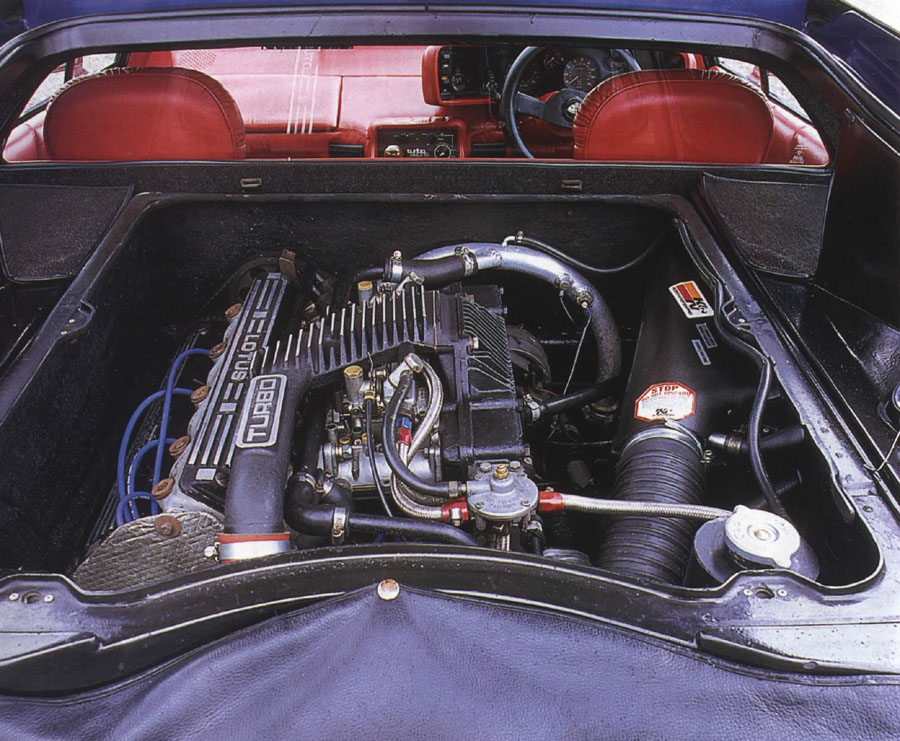
Turbo brought real performance at last in 1980, after V8 project
abandoned; 210bhp gave 0-60 figure of 5.6sec and claimed 152mph
There are things to watch out for. Some Esprits can catch fire if
the carburettors are worn out, allowing fuel to drip on to the distributor
with the inevitable result. Service everything when it is due; not
one mile later... If you need to replace a windscreen, it is a long,
tricky job, best tackled by a Lotus specialist. Much interior trim
has to come out and non-experts will almost certainly do some damage.
This tip came from Barry Ely, for 12 years the owner of the Commemorative
S2 seen here — guess what, it’s for sale and he’s
a Lotus specialist in Leyton, East London. To be fair, he points
out that screen replacement is not profitable — he just hates
to see Lotuses lashed up by bad workmanship and is happy to give
free advice to owners (call Barry Ely Sports Cars on 0208 558 3221).
Galvanised chassis were introduced with the S3 and the original
Turbo: so far all seem to remain as rust-free as the GRP bodies.
Some of the brighter exterior colours have faded but the mouldings
seem to be of excellent quality and extremely durable. The bodies
of the cars we photographed show no signs of crazing or cracking.
Good factory parts back-up means restoration is fairly easy. Obviously
an Esprit will be more expensive to rebuild than the average classic
but it’s a bargain by supercar standards: the four-cylinder
engines are a lot cheaper than the complex power units of exotic
rivals.
By the way, don’t fit silly wheels and tyres, or spacers.
Lotus took care to optimise its original specifications and such
nonsense won’t improve anything.
Wise owners belong to several Lotus clubs, gaining invaluable technical
advice and contacts from the most knowledgeable enthusiasts: there
are circuit-driving days to be enjoyed, too. One of the best this
year should be Silverstone GP Circuit (August 23, Lotus Drivers
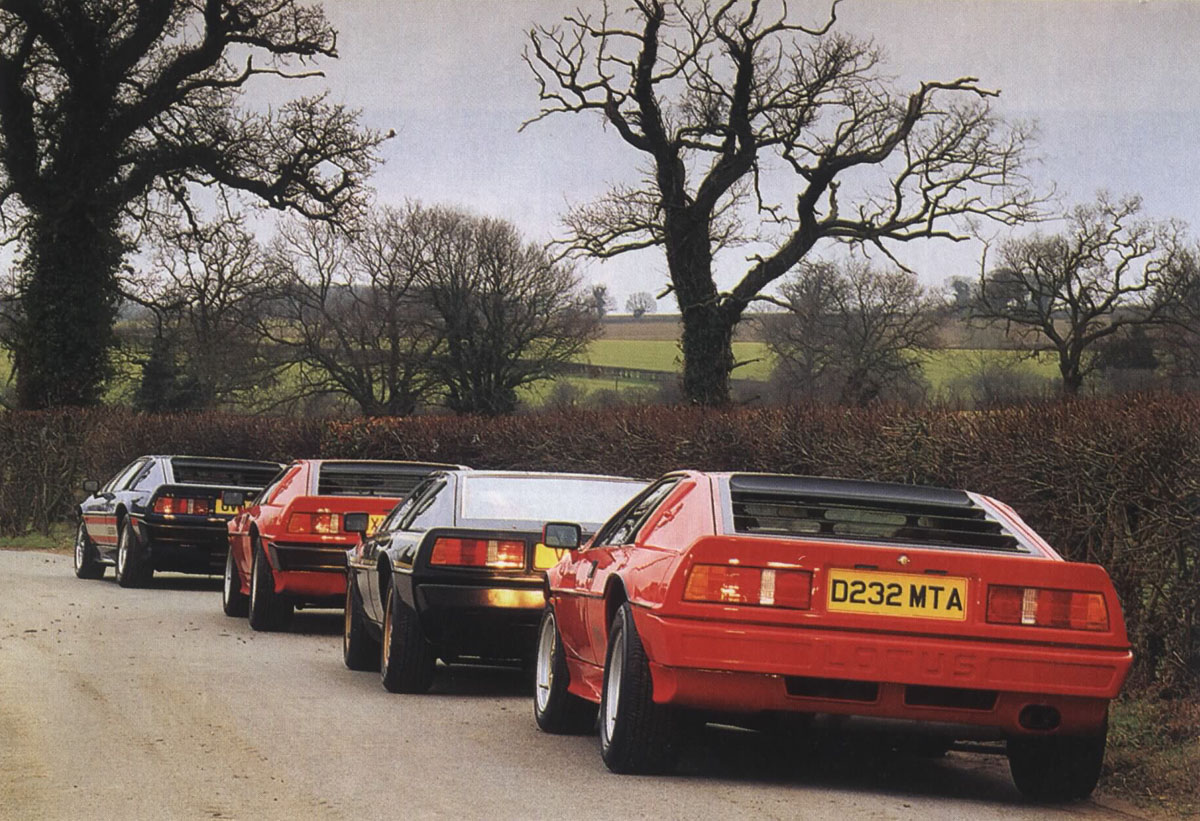
Club). The cars shown here were located for us by Club Lotus, organiser
of many events throughout the year.
BUYING AN ESPRIT
For
the many reasons given elsewhere in this article, it is worth going
for a later car: Lotus really was struggling to survive in 1975-1976
and the relatively undeveloped S1s were, as a result, not that well
built. Oddly enough, the market hardly seems to recognise this:
a good S1 might fetch £5,000 or more while an early S3 in
similar condition might be worth £6,000. A younger S3 HC in
superb order might go for twice that much, however Good early Turbos
start from about £10,000.
Everyone knows that service history should be checked on any used
car. With an Esprit you need to know every detail, so don’t
rely on the sight of a fat file of ‘full service history’
documents. I’d read every one, carefully. Where has it been?
What went wrong? Was everything really done on time? Has it been
to any of the many respectable Lotus specialists recently? If so,
ring them up and ask what they know about the car.
S1s and S2s may need driveshaft and rear suspension work. An Esprit
that sits low probably needs new springs and dampers. Look for cracked
and corroded exhaust manifolds. Check the cambelt on all Esprits
(and renew it regardless if you buy the car — failure if it
snaps might do £2,000-worth of damage). Listen for transmission
whines, as gearbox rebuilds are not cheap. Check the radiators on
early Turbos, as unnoticed partial clogging can cause a burnt-out
piston at sustained speed.
If you can satisfy yourself on all these points, there is no doubt
in my mind that it could be worth paying a little over the guideline
prices. An early Esprit Turbo is the bargain supercar par excellence
in the classic-car market. One of its great rivals when new was
the Ferrari 308GTB: see if you can get a decent one of those for
10 grand now... Only the contemporary Porsche 91 ISC Sport comes
close in value for money today; some distinctly inferior contemporary
rivals mysteriously fetch about twice as much as the Lotus and the
(slightly more valuable but magnificently engineered) Porsche.
Buying a used example of any of these cars is a risk. Your first
service may cost thousands, so never buy on impulse. An enthusiast
I know snapped up an apparent bargain, an Esprit Turbo that had
suffered a minor engine-bay fire. In repairing that, it steadily
dawned on him that his car had been neglected for years and butchered
occasionally by cowboy mechanics. By the time he had finished putting
it all right, it looked superb and went very well but he was older
and wiser, and his enthusiasm was gone — he went back to Jaguars.
Look around the car to see whether it appears to have received loving
care. If it’s a dirty mess with even the odd stripped thread
on the engine, be very suspicious. If you can’t find a perfect
example of the Esprit you are chasing, a not-so-good one (a restoration
case, really) should be easy enough to find at £3,000-£4,000.
Do try to be realistic about what it will cost to get it back into
the sort of state that will stop poor Cohn Chapman from spinning
in his grave.
Don’t forget to check for accident damage before you close
a deal. Evidence of a shunt is easy to spot. If you find any signs,
get a professional inspection.
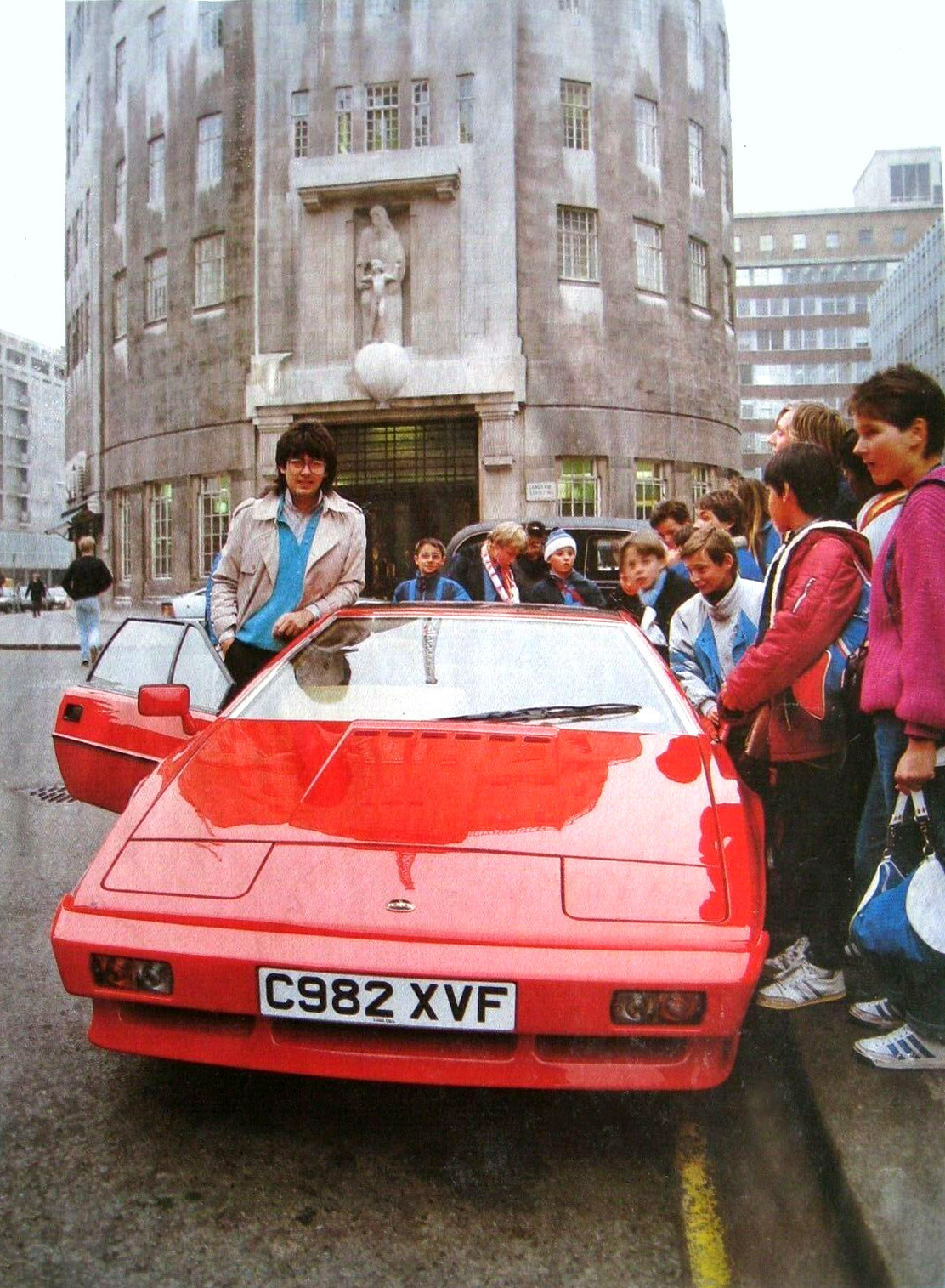
Cor,
look at that motor!” Esprit was a car to be seen in; this
one’s pictured with ex-Radio One DI, Mike Read.