




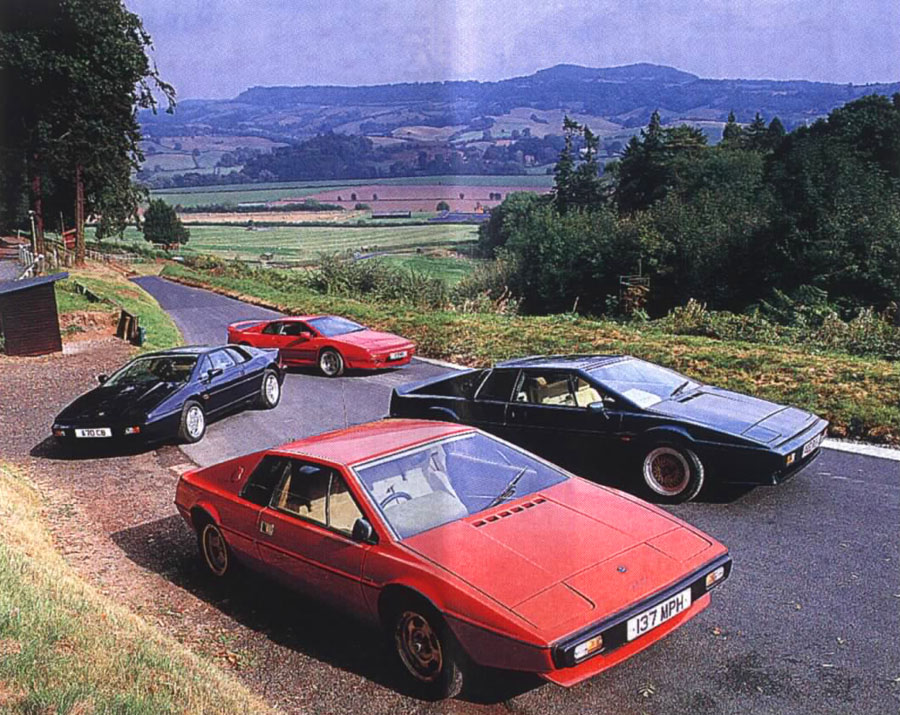
GENETIC
engineering
Lotus smoothed off the Esprit’s edges as
it evolved, but never blunted its impact,
says Alastair Clements
Natural selection is a wonderful thing. As time goes on only the strong survive and it’s why, more than 25 years after it hit the road, the Lotus Esprit still reigns supreme: A new V8 will set you back a flyer short of fifty grand, but go for a four-pot and you can pick up a legitimate Ferrari-beater for Fiat money. Some 9186 Esprits were built with the classic 16-valve slant-four from 1976-’99, and the extra good news is that, with 17 different models to choose from (plus five V8s), there is an example of this real-world supercar to suit every taste — not to mention every pocket.
Favoured shape of the ‘70s, the wedge was taken to its extreme
with the first Esprit proto-type, Giorgetto Giugiaro’s ‘Silver
Car’, star of the Ital Design stand at the Turin Show in
1972 that followed the similar Maserati Boomerang study. Based
on a Europa chassis, the Silver Car was developed by Colin Chapman’s
engineers at Hethel into the second mid-engined Lotus, with the
engine also mounted longitudinally, keeping the main mass forward
for opti-mum balance. But it was our years before project M70,
spearheaded by Mike Kimber-ley and Tony Rudd, hit the road, despite
looking much as the initial concept and using traditional Lotus
construction methods. Under the dramatic skin there was the familiar
steel backbone chassis and the glassfibre body was formed, as
on the Elite and Eclat, in two halves with the join disguised
by a pronounced rubbing strake along the flanks.
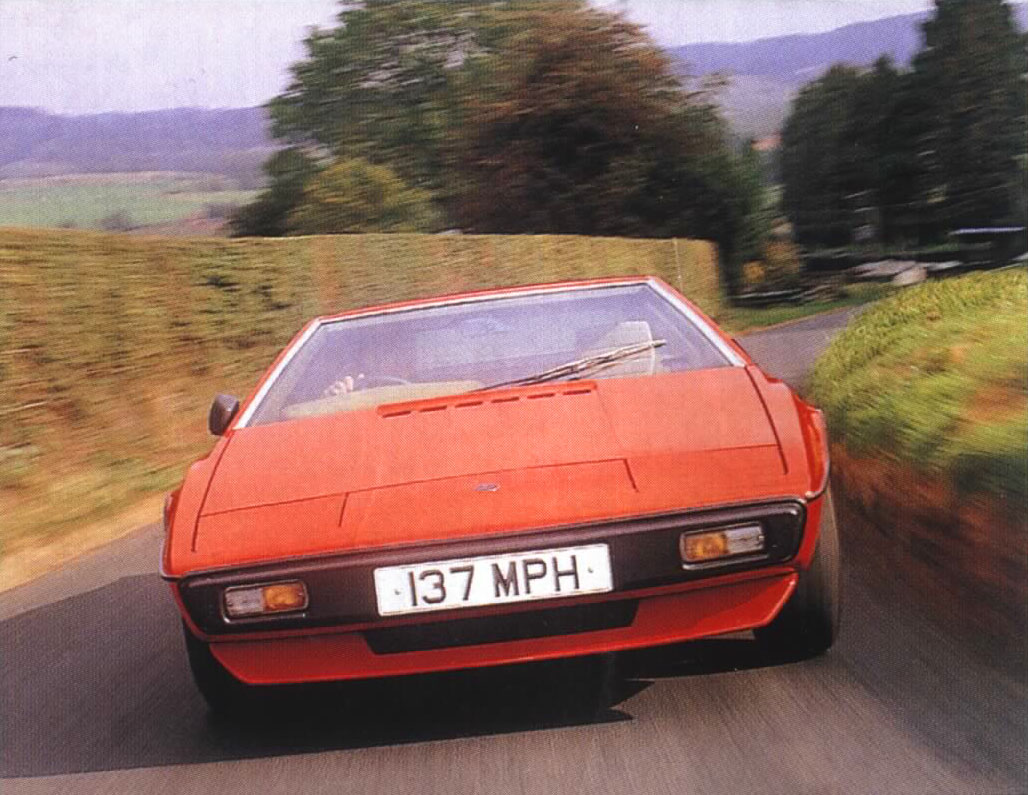
Lotus Esprit S1
The original Esprit has lost none of the drama that made it such a sensation in ‘76 and, even alongside its stylish successors, looks like a carelessly parked flying saucer. Hunkered over fat Wolfrace alloys, it’s hard to believe a car can be so low and still accommodate human beings, yet the prototype had been even more extreme, with a near-continuous line from nose to roof.
When tested with hindsight, the 51 is often criticised for performance
that doesn’t live up to the supercar tag, and it’s
true that, with just 160bhp to haul its 2000lb around, it wont
set the road alight. But it’s the way it delivers its performance
that impresses, and the confidence it inspires in the driver.
There are few cars of the Esprit’s size and ability that
can honestly be described as chuckable, but the S1 is one, thanks
mostly to incredibly sweet steering combining superb feedback
with lightness. The Esprit turns into corners with an urgency
that puts the contemporary Ferrari 308 to shame. Once into a bend,
so neutral is the stance and so massive the grip — despite
relatively skinny tyres — that you realise you could probably
have carried another 10mph. Big bumps will send a shudder through
the cabin, yet poor surfaces encoun-tered mid-corner won’t
disturb its composure when others would be heading for the verge.
Then there’s the response from its carburetted 1973cc ‘four’
— always instant and accompanied by an urgent growl—and
the snappy action of the Citroen gearbox, worked with a wooden
ball. With usable cars to be had for as little as £5000,
the S1 is the cheapest route into Esprit ownership. As is so often
the case, first is purest and the S1 best fits the dictionary
definition of the Esprit name, ‘sprightliness’.
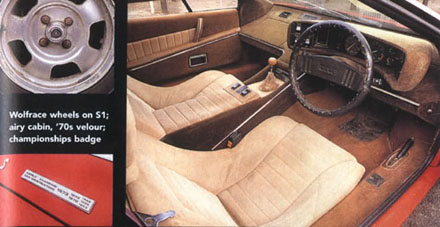
The first Esprit also offers a pleasant cabin ambience. If you can forget the earwax-brown velour, you’ll find a bright, roomy interior with electric windows, reclined driving position plus lots of head and legroom with the huge binnacle ahead stocked with garish green Veglia dials. Secure in the Esprit’s passenger safety cell — an innovation for the mid-’70s and surely a contributor to its easy federalisation — it’s easy to drift into dreamland. Peer out of that flat screen and you can imagine fish swimming by and seaweed snagging on the wiper: suddenly you’re Roger Moore, easing your supercar submarine out of the sea in the 1977 Bond flick The Spy Who Loved Me.
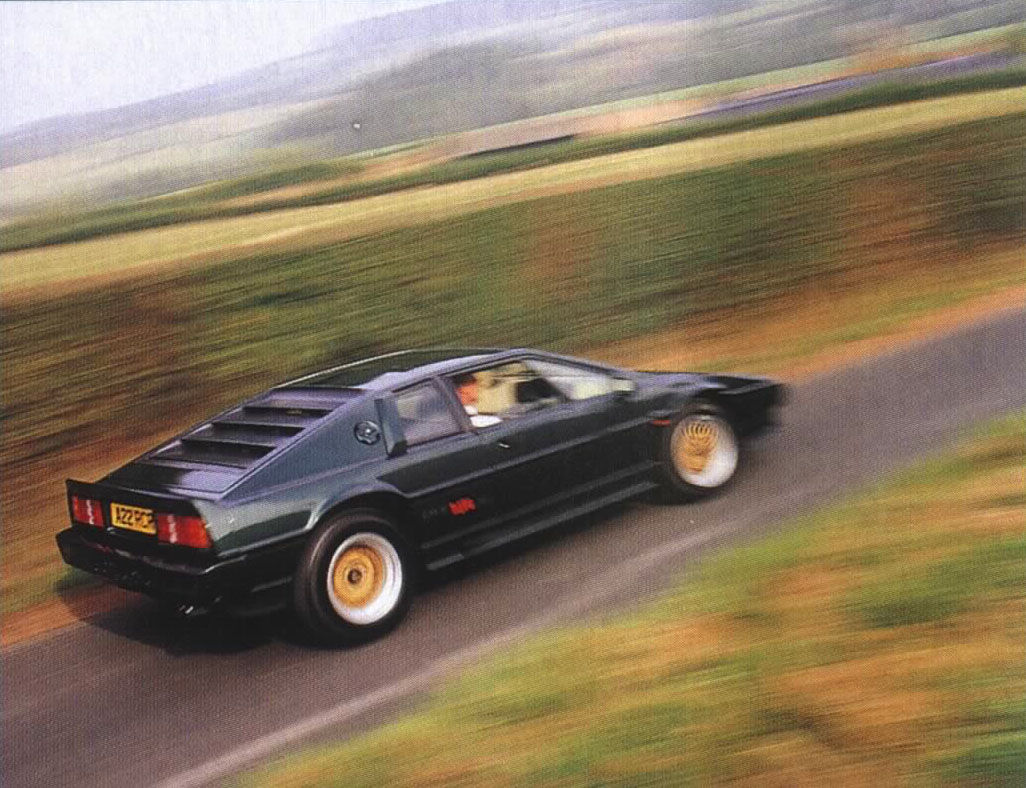
Lotus Turbo Esprit HC
If you have a penchant for playing secret agent then maybe a Turbo Esprit would fit the bill. Strap a couple of p airs of skis on the back and you could have rolled off the set of For Your Eyes Only. Launched at the Royal Albert Hall in 1980, the Turbo took the Giugiaro design on a step, adding cross-spoke alloys, body-coloured bumpers and garish decals to hint at the changes under the skin. This prime bedroom-wall fodder for junior petrolheads is now well within reach, with prices for early Turbos dipping well under the £10k mark.
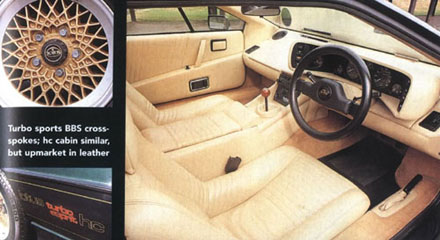
Inside,
it’s 11 years on and surprisingly little has changed. There’s
the same binnacle ahead, but topped with beautifully stitched
leather rather than velour, and the seats are more sup-portive,
gripping your backside better than the S1’s. The optional
glass roof gives a bright and cheerful ambience, but it’s
curiously cramped, the little wheel sitting low on your legs and
your left knee hard up against the gearbox tunnel.
King of the wedge turbos has to be the last-of-the-line ‘87
Turbo Esprit hc, with 215bhp and a whopping 2201b ft of torque
from its high compression engine (5bhp and 201b ft more than a
standard Turbo). With the engine stroked out to 2174cc and following
‘80s fash-ion with a Garrett blower, the Esprit’s
supercar credentials are clear. Use the full 0.67 bar boost pressure
and your hands instinctively grip the tiny wheel twice as hard
as the razor-sharp nose shaves the distance to the horizon. And
the sound is fantastic. Forget your howling sixes or burbling
V8s, nothing prepares you for the growl from the hard-working
‘four’ overlaid by roaring induction as the turbo
inhales: lift off and there’s an addictive fluttering whoosh
as the wastegate depressurises.
The Turbo’s chassis was revised to give a new engine bay shape and accommodate the improved rear suspension (upper and lower links replacing tailing arms and fixed drive-shafts) and the hc’s astounding grip makes it feel part of the road. Braking is exceptional and it has the same positive gearchange and sharp steering, but feels much heavier thanks to the combination of increased weight, a smaller wheel and fat tyres adorning those 15in BBS rims. It’s become a physical driving experience.
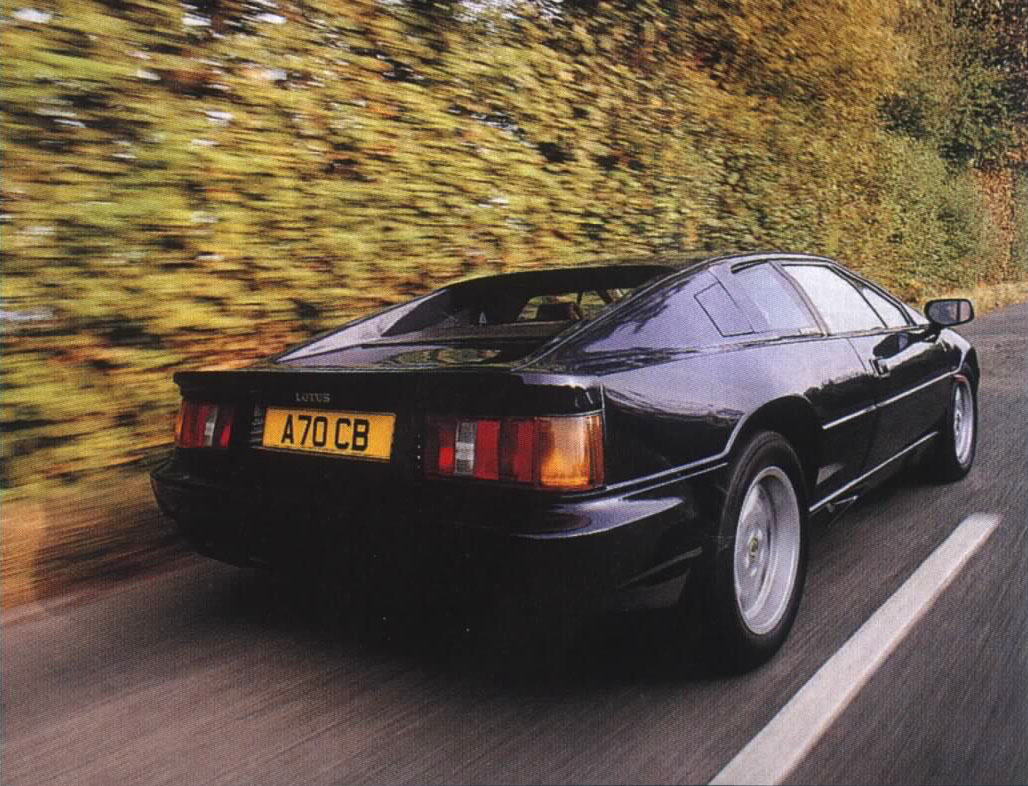
Lotus Esprit Turbo
After the drama of the Turbo Esprit, the Peter Stevens-styled Esprit Turbo is something of a disappointment. There’s the same slingshot acceleration, which kicked the Lotus into the Premier League, but it hasn’t really moved the game on. For a dramatic improvement, buyers a to wait until the chargecooled 264bhp SE, which took 0-60mph below 5 secs and top speed above 160mph. In some ways it’s almost a retrograde step: the hefty clutch operates a less physical gearchange, but the Renault 25 transaxle’s rubbery long-throw shift isn’t a patch on the SM unit. The fuel injection that replaced the twin Dell’ortos in 1989 cars makes it more refined, plus improved sound deadening means that, with the windows up, it’s the silent supercar: you’ve got to drop them to enjoy that exhaust blare and turbo whistle.
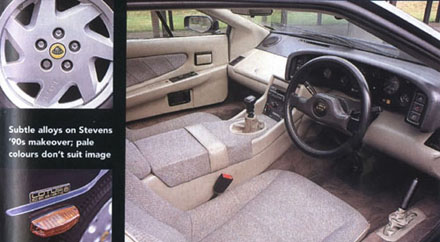
Inside,
quality seems to have taken a dive. The tan leather has been replaced
with tweedy cloth and anaemic pinky-grey surfaces that would look
more at home in the lounge of an old folks’ home. The switchgear,
borrowed from here, there and everywhere, feels mismatched, though
there is the odd neat touch such as an ice sensor on the dash
to warn you to watch your right foot in slippery conditions.
There are few complaints from the outside: the man who went on
to style the M100 Elan made an excellent job of refreshing the
Esprit with an all-new look~ yet minimising costs and retaining
the spirit of the original. Toyota tail-lights replace the hc’s
SD1 units and the elegant alloys complement the softer ‘90s
look. The only criticism is that the new car looks a bit anonymous
alongside the drama of the original.
The S4S is a different proposition altogether. Russell Carr’s
update adds aggression to scream its supercar status — a
maze of scoops and vents to cool brakes, engine, radiator and
occupants. It’s outrageous from its full-width shovel front
to carry-handle spoiler on the tail, with wheel-arch extensions
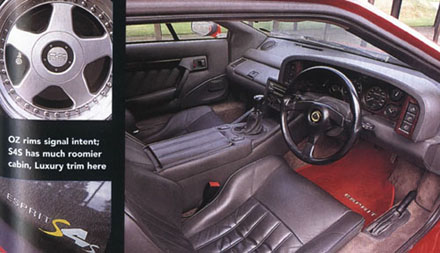
barely accommodating vast split-rim OZ alloy wheels hiding huge
brake discs and menacing black Brembo calipers.
Taller drivers will delight in the extra room of the long cabin,
brought in for the ‘92 Esprit SE and the supportive Connolly
leather seats, part of the ‘Luxury’ trim pack. Switchgear
is improved with Vauxhall column stalks and dash-mounted aircon
vents to avoid the frozen-knee syndrome of the Stevens car.
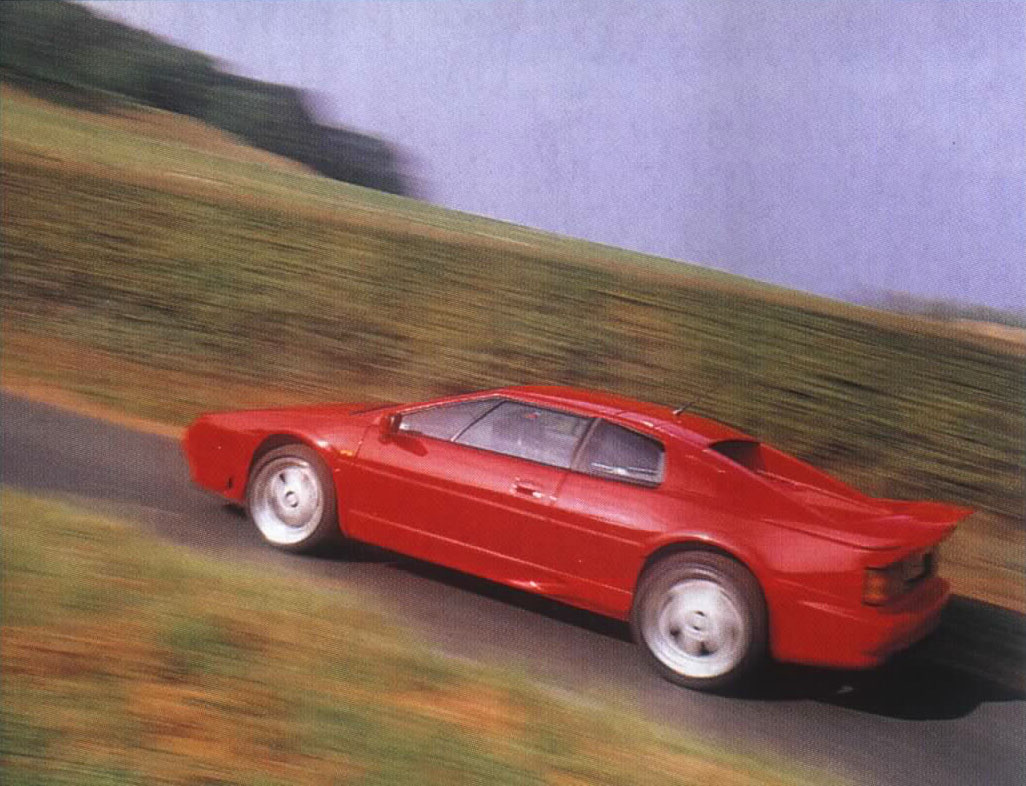
Lotus Esprit S4s
With 20 years’ development behind it, the S4S is quite some machine. While the GT3 holds court as the last four-cylinder Esprit, the S4S takes the prize as the greatest — mating the drama of the limited-edition Sport 300 road-racer with the comfort of the civilised S4. First thing to strike you is the eye-bulging braking power rather than its sub-5 secs 0-60mph and near-170mph potential. It’s not that it doesn’t feel fast, simply that the flat torque curve —230lb ft is available from 2500rpm and the full 290lb ft just 1100rpm later — and absence of lag signify readily accessible power throughout the rev range. But, get used to the heavy race-spec clutch and super-sensitive throttle, and the S4S has enough performance and ability to blow your mind.
The gearbox is a joy too: hard to believe that it’s based
on the same Renault unit, so different is the change from the
new internals and quick-shifter. The S4 was the first Esprit with
power steering and it’s superbly weighted, with bags of
feel bringing all the confidence of the S1 back to the driver
by giving the car a lighter, nimbler feel. Like the earlier cars,
its natural state is completely neutral, but there is so much
power that it’s easy to light the rear tyres in oversteer
when exiting corners. Unprovoked, the vast 245 and 285 Michelins
won’t be parted from the tarmac, no matter how hard you
try.
There’s no doubting that this quartet is from the same gene
pool and, 30 years on, Esprit attraction remains strong. The genius
of Lotus has been to continually refine that exceptional package
to ensure the car retained its allure generation after generation.
Buy well and the Esprit remains one of the few cars that can put
your head in the clouds while keeping your feet firmly on the
ground. The S1 offers the most fun, the most pure Lotus experience
of the trio for the least money. But fragility and reliability
worries are enough to deter most buyers. At the other end of the
spectrum, the S4S is spectacular, but double the price of the
classic Turbo. The decision is obvious — the only choice
is whether to go for Stevens or Giugiaro.
WHAT GOES WRONG AND WHAT TO LOOK FOR
1 History, particularly on post-52 cars, is very important. Make
sure it has been serviced regularly, preferably by a marque expert,
and has had regular cambelt changes (every 24,000 miles).
2 Look for cracked exhaust manifolds, a common failure and a tricky
job that can mean taking the engine out (up to 21/2 days’
labour).
3 Run the car up to temperature and watch for overheating, particulary
on pre-S3 cars with smaller radiators. Automatic fans can fail
(look for orange warning light on dash) and a blown head gasket
is a common result: make the usual checks (white smoke, white
goo on filler cap). At worst, the liners can sink, signaling an
engine rebuild.
4 Parts for the Citroen gearboxes on early cars are getting rare
and they need to be treated with respect. Later Renault-derived
‘boxes are stronger and parts plentiful.
5 Steering racks on pre-power assisted cars are weak and wear
out: watch for slop and play in the steering. They can also be
damaged if not fitted by experts so check even if replaced recently.
6 S1 and S2 cars use the driveshafts as top link at the rear so
wear out their universal joints and wheel bearings quickly —
look out for slop and noise from the back end.
7 Underbonnet heat can be a problem with S1/S2, causing fluids
to boil and failure of ancillaries such as master cylinders and
coils.
8 It’s a supercar and so not a DIY proposition. Buying from
a specialist is recommended: if buying privately get an expert
to check it over; a bad one will be cripplingly expensive to put
right.
ESPRIT FROM A-Z
|
1972
‘Silver Car’ concept, based on Europa chassis,
displayed on Giugiario’s Ital Design stand at Turin
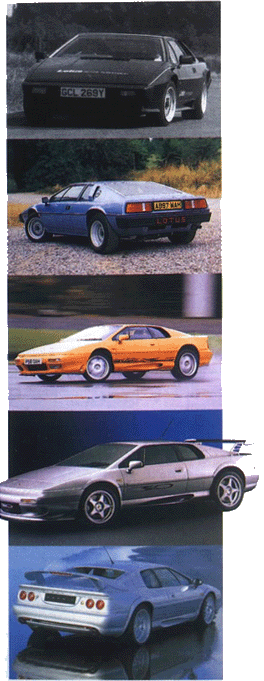
Motor Show in November. 1975 Completed car displayed at Paris Motor Show, October. 1976 Type 79 Esprit goes into production. 1978 Esprit S2 launched with Speedline alloys, new front spoiler, improved rear suspension and redesigned engine cover. Esprit JPS (above) arrives in October, limited run of 100 black and gold cars celebrating success of the Type 79 F1 car. 1980 Type 912 2.2-litre engine (with new camshafts and re-jetted twin-choke carburettors) added to create Esprit S2.2, followed by 210bhp Type 82 Turbo Esprit with aerodynamic aids and revised chassis, first 100 cars in blue, red and silver livery of F1 sponsor Essex Petroleum. 1981 Type 85 Esprit S3 arrives as cheaper base model, retaining 2.2 engine. 1982 Prototype active suspension Esprit (left). 1987 High compression 215bhp Turbo Esprit hc introduced as last Giugiaro car (second photo down). Peter Stevens-styled update follows in October as Esprit NA (normally aspirated) and Esprit Turbo. 1988 Limited run of 40 pearlescent white Esprit Turbos to mark Lotus’ 40th anniversary. 1989 Esprit SE with 264bhp, fastest Lotus to date with a top speed of 163mph. 1990 Esprit enters USA SCCA Race Series, finishing second overall and spawning 20 X180R replicas for the US market. 1991 Esprit SE ‘High Wing’ launched at British Motor Show in October. 1992 Dramatic Esprit Sport 300 revealed at British Motor Show, developed from X180R with lightweight body, racing brakes, optional roll cage and 300bhp. 1993 Lotus enters Le Mans with two Sport 300 racers. Facelifted Esprit S4 arrives with revised bodywork, by Lotus Design under Julian Thomson, and standard power steering. 1994 Esprit S4s unveiled at the British Motor Show. 1995 Esprit Sport 300 racer enters GT2 category of the global endurance GT championship. 1996 All-new Esprit V8 arrives at the Geneva Motor Show in March, powered by twin-turbo, 32-valve, 3.5-litre V8. Esprit GT3 introduced as base model featuring a 2-litre turbo engine (third pic down). 1997 Esprit V8 range expanded with more basic (and lighter) GT and plusher SE. All cars get new interior with a smaller instrument binnacle. 1998 Most extreme Esprit arrives at Birmingham Motor Show: 175mph Sport 350 (fourth pic) with adjustable boost, carbon-fibre rear wing and magnesium alloys. 1999 Esprit GT3 phased out due to emissions regulations, marking the end of the four-cylinder. 2000 10,000th Esprit built. 2001 Final incarnation revealed in November, the 2002 Model Year Esprit. Restyled by incoming head of design Russell Carr with Elise-style rear lights and Sport 300-style rear wing (left).Bond-ed Esprits: S1 in The Spy Who Loved Me (left), hc in For Your Eyes Only |
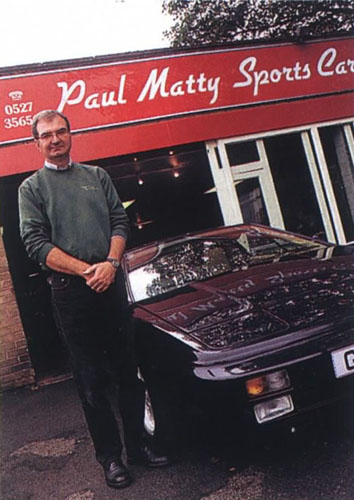
Paul Matty next to a Stevens Esprit Turbo
WHICH ONE? THE EXPERT’S CHOICE
Lotus guru Paul Matty (left, with Turbo: 01527 835656, www.paulmattysportscars.co.uk)
reckons the Esprit’s time has come as a classic: “It’s
a good time to buy as they a building the last run. If you’re
after a Giugiaro car then the JPS is nice and the S1 appeals as
there are few left. A normally aspirated S3 can be a really nice
car and an hc is rare and drives well. You can still use a later
one every day: with a glassfibre body and galvanised chassis they
should be around for a while yet. We have customers running Peter
Stevens cars with over 100,000 miles on them and they’re
still great. S1s and S2s tend to be a labour of love: they are
much better cars today and appeal through Iack of complexity.
The S4 and S4s resolved the problems and have better gearchange,
power steering and better build quality. The S4 is a landmark
and not a lot of money, but the ultimate to keep will be the S4S,
it’s a corker with all the V8’s looks and that fantastic
little 300bhp four-cylinder. The V8 is blistering, but go for
post-’98.”
HOW MUCH WILL IT COST?
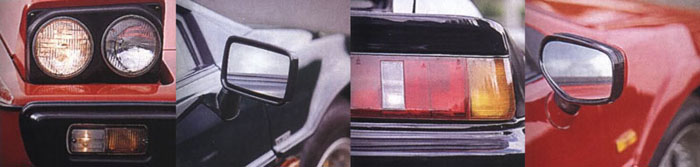
Basic 6000-mile service (no extras) — £400-500. Cambelt
service (no extras) £700-1,000 (£800-1,000 for S4/S4s).
The earlier the car, the less chance of a straightforward service
without extra costs. Engine rebuild £4000-5000 Gearbox rebuild
£1380 (Citroen/Maserati), £1170 (Renault). Front brake
disc S1: £28.73 (£19.09*); HC: £128.71 (£43.89*)
S4s £128.55. Rear brake disc S1: £105.75; HC: £78.82;
S4s: £130.20. Headlight S1: £49.16; HC: £53.46*;
S4s: £79.24. TaiI-light cluster S1: £22.38; HC: £99.88*;
S4s: £119.06. Steering Rack S1: n/a; HC: £416.35 (£229.13
exch*); S4s: £1152.63. Exhaust S1: £133.84 (rear box);
HC: £722.63 (System); S4S: £425.24 (silencer). Door
S1: £210.10; HG: £387.99; S4s: £577.45. Front
tyres S1: £76.96*; HC: £76.96*; S4s: £138.06*.
Rear tyres S1: £103.11*; HC £113.98*; S4s: £226.78*.
*aftermarket rather than genuine Lotus part
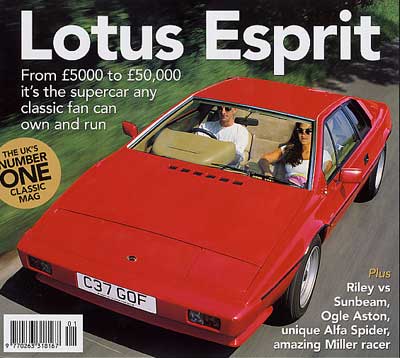
To purchase a back copy of Classic Cars magazine, please vist the website: www.classicandsportscar.com