




Lotus Esprit
Classic & Sportscar
by Mark Hughes, photos: James Mann. March 2000
Hallmarks
of any mainstream Lotus are cutting-edge styling, rust-free bodywork
and vivid acceleration, achieved through a gutsy power unit and
lightweight engineering. The Esprit fits that tradition perfectly,
Turbo versions in particular satisfying any performance freak
with their 150mph capability. But any of the myriad Esprit versions,
with their race-bred mid-engined configuration and Dan Dare looks,
are so enticingly inexpensive to by – just £5,000
for a decent S1 or £15,000 for an SE Turbo – that
you wonder why anyone should want to opt for a Porsche or Ferrari
instead!
Owners views
If accountant Nigel Hawkins' experience are anything to go by,
running a classic Esprit as daily transport makes good financial
sense – as well as being fun. His non-turbo 1989 car, which
has done 60,000 miles in five years, has been such a dependable
companion that he now wants to upgrade to a more recent Turbo.
Nigel admits that servicing hasn't been that cheap compared with
a modern car, but low depreciation counterbalances this to give
an annual running cost (excluding fuel and insurance) of £2,000.
Servicing accounts for £1,400 (including £300 for
tyres), while depreciation runs at £650 a year (the car
cost £14,500 in 1994 and should command £11,000 now).
The
only significant problem in service has been an exhaust gasket
failure (manifolds can crack because of water from the rear wheels
splashing on to them), while problems with electrical components,
particularly window motors, seem to be a feature of Esprit life.
University lecturer Aubrey Arrowsmith owns possibly the best original
Esprit Turbo there is. His black 1989 car, which features in our
Porsche 944 Turbo comparison, has only 2,500 miles on the clock
and every detail – right down to the last nut and bolt –
still looks factory-fresh.
Body, style and interior
If you're tempted by an Esprit, style is sure to be one of your priorities. When first seen in concept form at the Turin Show in 1972, Giorgio Giugiaro's dart-shaped outline was breathtakingly modern; in the early years buyers really could believe they were driving a vision of the future. The looks dated as years passed but, in 1987, in-house designer Peter Stevens produced an inspired update that gave the car a new lease of life; production of this softened shape continues to this day (production finished February 04). They're all great cars, so choose the style you prefer: the classic '70s evocation of the original or the contemporary resonance of the post-1987 look.
Glass-reinforced plastic (GRP) body construction is one of the Esprit's best virtues. As will all post-1975 Lotuses, bodyshell manufacture used the vacuum-assisted resin injection (VARI) method, whereby two huge 'bathtub' moulds produce upper and lower body halves that are bounded around the waistline. This Lotus-patented process makes for an exceptionally strong, simple and durable structure that's almost immune from the stress cracks found on earlier Lotuses – typically at panel corners and from stone impacts in the wheelarches. The body just seems to last and last, the only problems arising from cash damage. Bolted-in door beams and an integral roll cage add to strength. The entire structure is actually quite heavy by Lotus standards, as anyone who has ever pushed an Esprit can testify. Equally resilient is the backbone chassis that's bolted beneath the bodyshell – although an accident can cause distortion – and corrosion occurs on pre-galvanised S1/S2 models. A chassis should never be repaired because rigidity and strength are compromised: the solution to any alignment or rot problems is always to fit a new galvanised chassis, which is likely to last almost indefinitely. One benefit of an Esprit is that 'rolling restoration' is feasible: the condition of a mid-priced car can be improved in stages, as and when money allows.
Bonded 'screen seal on S1/S2 models was high-tech for the time,
but 'Solbit' method hasn't lasted well: these early cars often
need resealing. Also check dash' and footwells for damp-induced
deterioration. Softness of aluminium trims around front and rear
'screens on all Giugiaro cars means they can't be re-used when
replacing the glass.
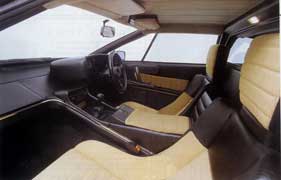
Low-slung seating, spaceship design and sometimes adventurous
materials make an Esprit cabin very inviting and purposeful, but
condition affects value. Leather (available as 'half' or 'full')
can become worn and cracked on high seat edges (particularly on
the driver's side), while pale colours can look soiled. Seat inserts
were initially plaid fabric, then Marquasite (similar to crushed
velvet). Full-size glass sunroof (available from the S3) is a
nice option. Turbo SE is a top-sec car, with burr walnut dashboard,
full leather and air conditioning.
Paint quality can remain good, but red seems prone to oxidising
and fading. Stone chips on the nose are common, but easily rectified
by a front-end respray as and when it can be afforded –
a beauty of GRP. Localised blowing-over is no good: old paint
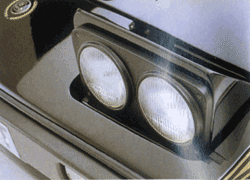
must be removed before new is applied. An S1 may display damage
near the front of the bonnet, which can hit raised headlamp pods
when opened; bonnet hinges were consequently modified for the
S2.
Poor accident repairs are the only fear with body, Good workmanship
should be invisible and long-lasting, but corner-cutting in bonding
or repainting will be revealed by paint problems, poor surface
profiles and even splits; check wheelarches particularly carefully.
Lotus makes all GRP panels, so anything from a front corner to
a full bodyshell can be replaced new; secondhand panels keep costs
even lower.
Chassis corrosion can occur on a pre-galvanised backbone (S1/S2),
particularly at the top, where an insulating layer of felt absorbs
moisture. Upper parts of the chassis are impossible to see, but
tapping with a hammer provides clues: anything other than a crisp
'clang' suggests rotten metal. Galvanised chassis were fitted
to all post-1981 Esprits, and are now often found on earlier models
as replacement units; these simply don't rust, even nearly 20
years on. A chassis must be inspected on a ramp.
Star-shaped cracks are sometimes found on the nearside rear wing,
as a result of something loose and heavy sliding across the boot;
the offside wing is protected by the battery.
Chassis replacement sounds horrendous, but the cost isn't eye-watering
compared with a job of similar magnitude on a steel-bodied car.
Around £3500-£4000 is the realistic all-in cost when
a specialist does the job: this breaks down to £1400-£1500
for the chassis itself (depending on model), £1000 for labour,
and £1100-£1500 for ancillary work that's wisely done
at the same time (for example, replacement of suspension bushes,
brake pipes and steering rack).
Powder-coating on window frames wasn't of the best quality, so
the surface often breaks down, allowing corrosion to set in. A
new finish can be applied if caught early enough, but replacement
frames are available.
Technical & mechanics
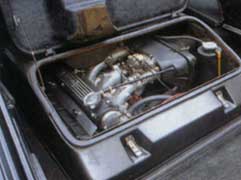
True to its record of nearly 30 years in service, Lotus' twin-cam
four-cylinder is a jewel. Through the period covered here, it
comes in three variations: type 907 2-litre, type 912 2.2-litre
the type 910 2.2-litre turbo. All last reasonably well, reaching
about 100,000 miles before overhaul is necessary, provided they
are serviced properly (every 6000 miles) and driven with respect
(gently until warm), so get as good a picture as possible of an
individual car's history. The high compression (HC) engine used
from '86 is significantly stronger, thanks to improved cam belt,
carriers and covers, plus pistons (Mahle forged aluminium rather
than cast), liners (Nikasil instead of cast iron) and turbo installation.
One tip when buying is to ask the vendor to start the car from
cold. Apart from watching the exhaust, check that the engine is
fired with minimal revs – a sign of sensitive treatment
– because the position of the oil pump, high on the engine,
means that it takes a long time to draw oil from the sump. Some
big-end noise is inevitable during the first few seconds, but
excessive rattling tells a story. To minimise this trait, it's
also important that the engine has a Lotus-supplied oil filter,
containing an anti-drain valve. Oil pressure when warm should
be 35psi and 3500rpm.
Engine temperature and evidence of overheating need to be assessed.
Radiator and fan specification were updated several times to cure
marginal cooling, but , as a car ages, water system problems can
develop and the all-aluminium engine can get too hot, leading
to head gasket failure and even a warped cylinder head. The radiator's
low-slung position in the nose also makes it vulnerable to damage,
allowing water to leak out unnoticed.
On
pre-HC engines, which have a square-tooth cam belt and an automatic
tensioner (the first year of the S1 is an exception with a manual
tensioner), play develops in the tensioner and eventually the
belt jumps off the gears. The belt must be changed every 24,000
miles, whereas the interval for HC engines – with a round-toothed
belt and manual tensioner – can stretch to 36,000 miles.
Pre-HC Turbos have an external wastegate with inefficient lubrication,
resulting in a tendency for the wastegate valve to stick (especially
on cars used infrequently) and sometimes the surrounding area
of manifold to crack. If the valve sticks shut, the engine will
perform well – until it breaks a piston. If the valve sticks
open, the engine will feel sluggish because boost is constantly
dissipated. The HC wastegate, by contrast, is built into the turbo
unit and is fairly trouble-free.
On earlier cars, 2-litre type 907 engines tend to leak oil from
the cam carriers and covers, causing smokiness when drips fall
on the exhaust manifold. Don't be tempted to prevent leaks by
tightening the cam carriers (threads in the aluminium casting
will strip) or the covers (these will distort). The first 2.2-litre
engines in the 'S2.2' have mostly had to be rebuilt because of
inadequate oil feed to the rear main bearing. On cars built before
the early '80s, the oil cooler is in a void near the offside rear
brake disc, making it vulnerable to stone damage.
Some points across all models are that tappets need to be checked
regularly (valves can burn out fairly quickly if they're tight),
engine mounting bolts can break, and exhaust manifolds can crack.
Technical Problems
S1/S2 rear suspension design creates an unfortunate appetite for
driveshaft Ujs and outer wheel bearings, owing to the fixed-length
driveshafts serving as upper suspension links. Avoid continuing
problems by fitting correct greasable Hardy Spicer Ujs (not cheap
substitutes), and greasing them regularly. Wheel bearings (Maxi
fronts) come with insufficient grease in the ball-races, so more
should be added; to avoid pressure on the bearing, fitting is
best done by chilling the bearing and heating the rear casing.
The S3's revised rear suspension, with top links and CV joints,
is trouble-free.
Double-wishbone front suspension can be troublesome on cars built
before 1985, when Toyota parts were introduced. This later, maintenance-free
set-up is brilliant thanks to improved geometry, giving better
turn-in and lighter steering. Earlier suspension is Elan-like,
with turnnions that need regular oiling (not greasing). Lower
wishbones can sometimes crack near anti-roll bar mountings.
Steering rack is prone to wear on all cars, but the different
rack of S3 and later models suffers the worst: wider wheels and
tyres put more load into it. Steering column Uj on S1/S2 Esprits
tends to seize if not greased at service intervals.
Five-speed gearbox is from Citroën-Maserati on Giugiaro cars,
Renault 25 on Stevens versions. Earlier unit can suffer spigot
bearing failure from lack of grease, leading to gears becoming
difficult to disengage and noise when releasing the clutch; 'cross-rod'
parts of rod-and-cable linkage can also become stiff. The Renault
'box and its cable-operated linkage are more durable. Clutch slave
cylinder has a short life on earlier cars.
Handbrake can seize as there's no provision for lubrication. Lever
is located in the sill, where it catches trouser-legs (until a
fly-off version came along in 1985) and gets kicked, sometimes
leading to mounting breaking away on S1/S2 models; a strengthened
mounting was introduced for the S3.
Electrical equipment needs thorough checking, although reliability
was progressively improved. High engine-bay temperatures on S1s
(and to a degree S2s) account for some problems, such as short
coil life. Fuses are in the glovebox, where they can get knocked
when stuff is thrown in. Window motors are prone to corrosion
and seizure because water leaks past the seals at the base of
the door glasses.
Market view
It's a rough rule with Esprits that values reduce as you go back
in years, so an S1 or S2 – values for which are much the
same – is the entry level. It can be argued that prices
of about £5500 for an average car and £7000 for a
cracker are quite low for the first editions of a car that's still
being made (production finished Feb 2004), when you consider that
many other classics – E-type and XK120 are great examples
– are worth the most in their earliest form. Early Esprits,
of course, are the most flawed, but the tide of values might turn
in years to come.
The marketplace takes a jump with some of the scarce models that
followed, although the 'S2.2' (only 88 were made) is an exception
because it isn't highly regarded. The two jewels are those dressed
in Lotus F1 colours, top-end values being £12,500 for an
S2 JPS and £16,000 for an Essex Turbo. Interiors were special
features of these models, so good originality inside is important:
a JPS is trimmed in black leather with yelloy ribbed velour inserts,
while an Essex Turbo has red leather (which can fade to orange)
and a roof console containing a radio and tape player.
Subsequent Giugiaro-shape Turbos peak at about £10,000 for
a non-HC and £13,500 for an HC, such is the perceived advantage
of the 1986 engine revisions; and most of these later models seem
to have been kept in good condition. Normally-aspirated S3s trail
by a few thousand and make excellent buys at between £7,000-£9,000
for honest examples that should need no work.
Prices jump for Stevens-shape cars, with an early Turbo at £9,000-£11,000
and peaking at £16,000; normally-aspirated models are naturally
cheaper, by about £2,000. The 264bhp SE can climb as high
as £20,000, but £14,000-£16,000 is a reasonably
safe range in which to buy.
Most earlier Esprits are still largely original in condition,
but a few are now being restored. The range of usage experienced
by the cars is enormous: high-milers often had business use (in
all weathers) through their early years, but some have been driven
sparingly since new. Ideally you want a car on which care and
money have always been lavished – the kind of owner who
wants to run a flash motor on very little money leaves a legacy
of neglect. The old adage 'buy the best you can afford' definitely
holds good with the Esprit.
A final tongue-in-check point. Don't buy when the film Pretty
Woman, which features an Esprit in its opening sequences, has
just been on TV; would-be Richard Geres tend to go into Lotus
dealers looking for the essential accessory to seduce their own
Julia Roberts. For that matter, the same probably applies to The
Spy Who Loved Me and For Your Eyes Only, in both of which 007
drives an Esprit.
Conclusion
Apart from driving one, the best thing about owning an Esprit is its relative immunity to decay. Yes, an abused engine or gearbox can give trouble, but any cared-for car – particularly post-'81 models – should be a safe but exciting place to park your money, thanks to the durable GRP body and a galvanised chassis. As long as you seek expert confirmation before thinning your wallet, you shouldn't go wrong with an Esprit. It's such an inspiring car to be in, to be seen in, and to have on your driveway. Like Ferrari, Lotus was a Grand Prix force when the Esprit was in it's heyday, and that attached glamour alone is convincing proof of our belief that connoisseur interest in this enduring design can only increase.
Which is Which?
Giugiaro Shape
S1 June 1976 to May 1978, 1973cc, 160bhp @ 6200rpm, 140lb ft @
4900rpm, 124mph, 0-60mph 8.4secs (autocar figures). Production
744.
S2 June 1978 to January 1980 Revised front spoiler, air ducts
behind rear side windows, numerous interior changes (new Smiths
dials different switchgear, trim), Speedline alloy wheels. Production:
1060.
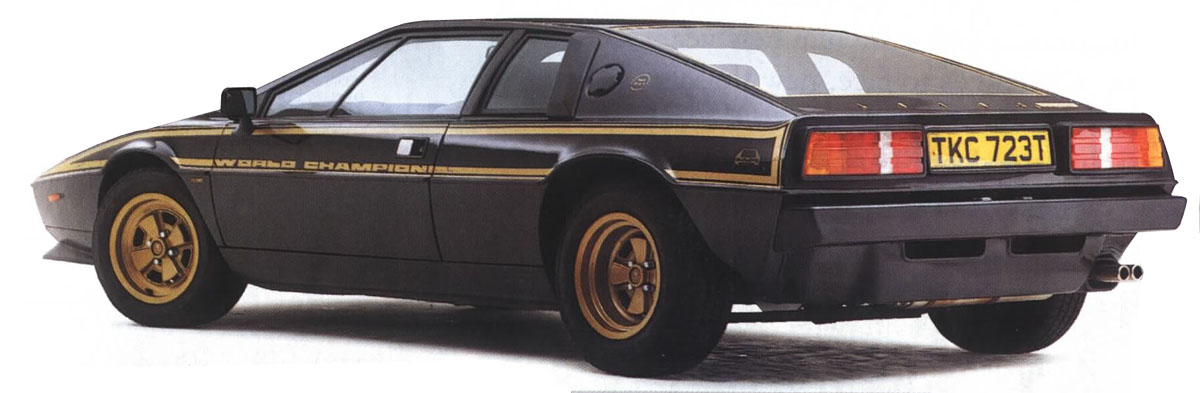
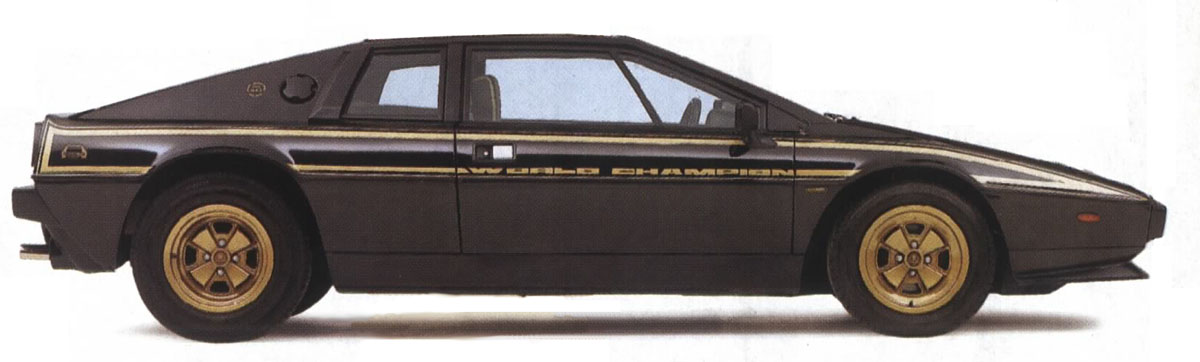
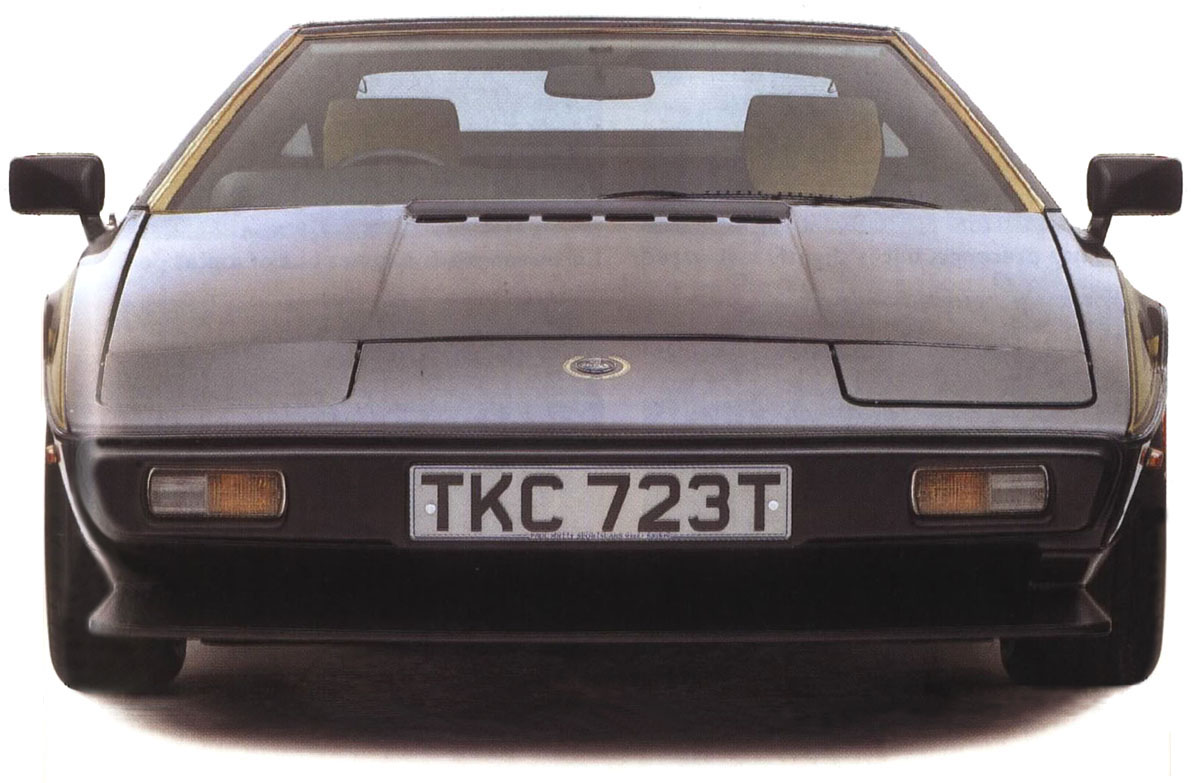
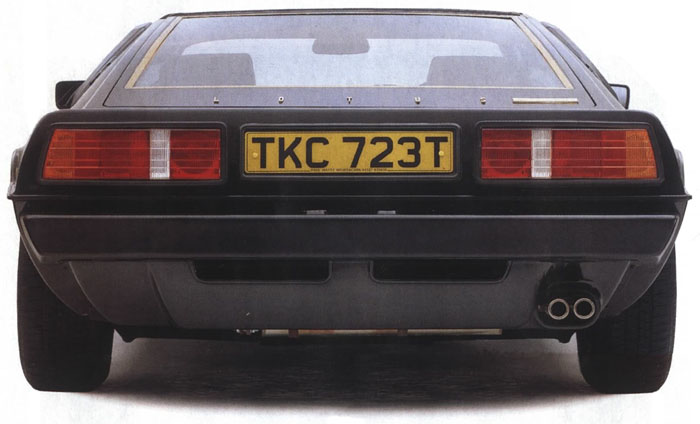
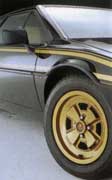
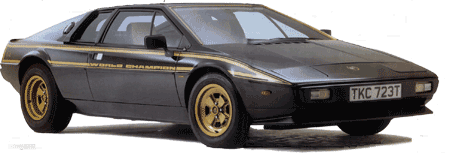
S2 JPS 1978-79 commemorative model in black with gold detailing:
three-spoke 'wheel instead of two-spoker. Production: thought
to be 147.
S2.2 February 1980 to March 1981, 2.2-litre (2174cc), 160bhp @
6500rpm, 160lb ft @ 4900rpm, 138mph, 0-60mph 6.7sec (Lotus figures).
Galvanised chassis. Production: 88.
Essex Turbo, February 1980 to April 1981 Limited-edition Turbo
in Essex livery (Lotus' GP sponsor), 210bhp @ 6250rpm, 200lb ft
@ 4500rpm. Dry-sump lubrication, roof console and Compomotive
split-rim alloys, 150mph approximately, 0-60mph 5.6secs (Motor).
Production: thought to be 100.
S3, April 1981 to October 1987 Significant chassis/suspension
changes (as per Essex Turbo) plus many cosmetic revisions, 135mph,
0-60mph 6.5secs (Autocar & Motor). Production: 767.
Turbo, April 1981 to October 1986 Cheaper 'production' version,
with reduced trim spec; except for earliest models, all have wet-sump
lubrication, BBS wheels. production: 1608.
Turbo HC, October 1986 to October 1987, High-compression version
(up from 7.5:1 to 8:1), with Mahle forged pistons and new exhaust
manifolds, 215bhp @ 6000rpm, 220lb ft @ 4250rpm, 152mph, 0-60mph
5.5 secs (Lotus figures). Production: n/a (but 40 anniversary
cars celebrating 21 years in Norfolk).
Stevens Shape
NA, October 1987 to September 1990 (no normally aspirated Esprits
after this date). Engine improvements brought into line with Excel,
172bhp @ 6500rpm, 163lb ft @ 5000rpm. Gearbox from Renault (previously
Citroën) on all new-shape cars. Production: n/a (10-15% of
total).
Turbo, October 1987 to 1991 Engine as previous Turbo HC. Production:
n/a
Turbo SE, May 1989 to 1992 Chargecooled derivative, 264bhp @ 6500rpm,
261lb ft @ 3900rpm. Aerodynamic revisions, best interior, 159mph,
0-60mph 4.9secs (Autocar & Motor). Production: n/a
Turbo SE 'Highwing' October 1992 to 1993 Race replica with large
rear wing and revised interior to give more room. Production:
20.
Note:evolution continued in the '90s; highlights are S4 from 1993,
V8 from 1996, GT3 from 1996.